Carhartt Tags by Year: How to Date Any Vintage Piece
Verified 2026-07-21.
You can date most vintage Carhartt in about ten seconds once you know where to look. The tag carries three signals a reseller cares about: a date code that gives the exact month and year, a union label that separates the valuable older pieces from newer imports, and a tag style that pins the era even when the code has worn away. This guide reads all three, and flags the markers that add money.
Key takeaways
- Many Carhartt tags carry a 3-4 digit date code: the last two digits are the year, the first one or two are the month (598 = May 1998).
- A small red-and-blue circular union label means US union labor, pre-2000s, and usually a resale premium.
- White cloth neck tags point to the 1970s; blocky ‘Made in USA’ tags to the 1980s-90s; white vinyl tags with style codes to the late 1990s onward.
- The modern ‘C’ logo dates to 1966, so the logo alone only tells you pre- or post-1966.
- Style codes like J97 and fabric codes like BLK identify the exact garment and colorway.
How to read a Carhartt date code
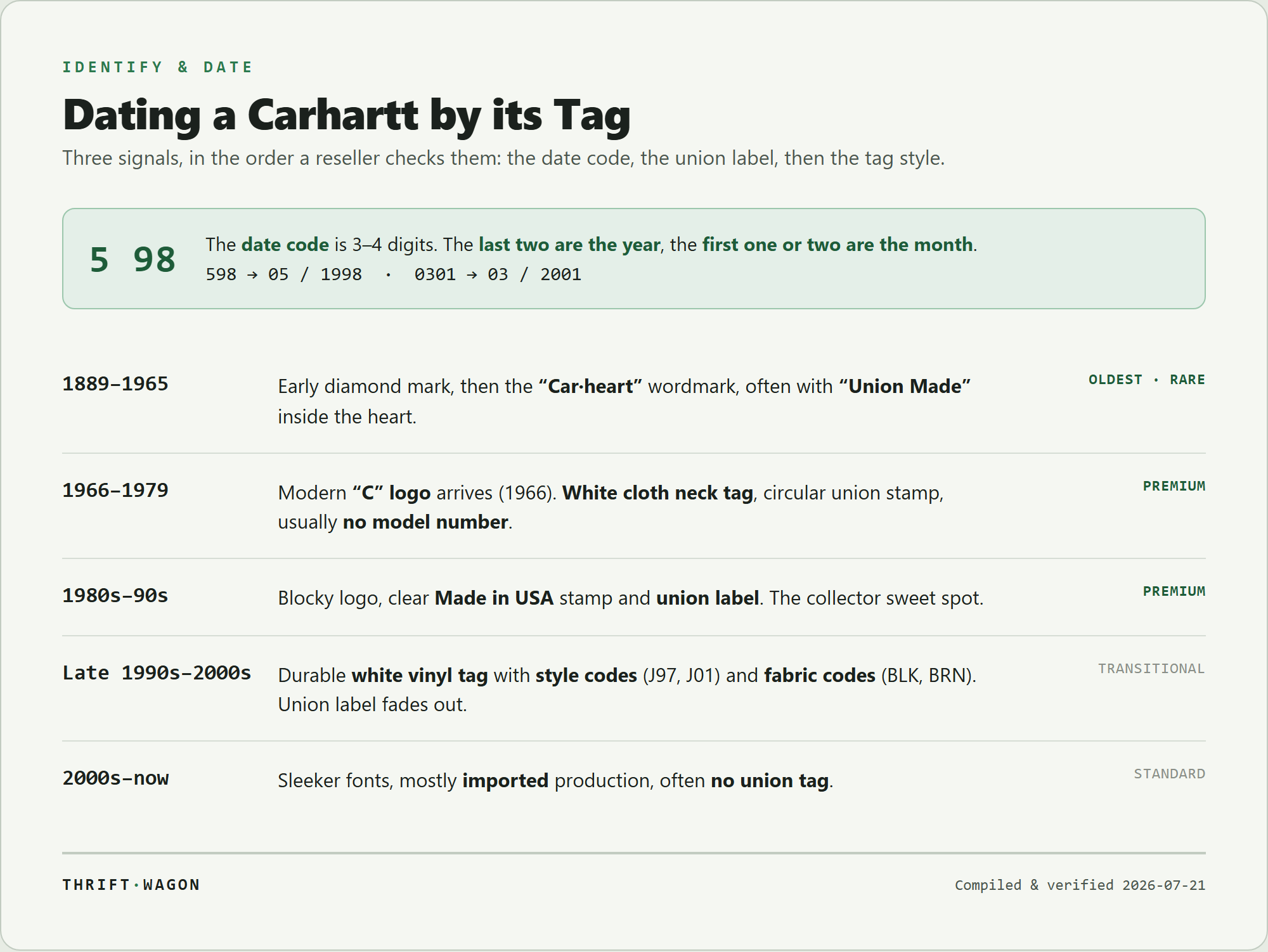
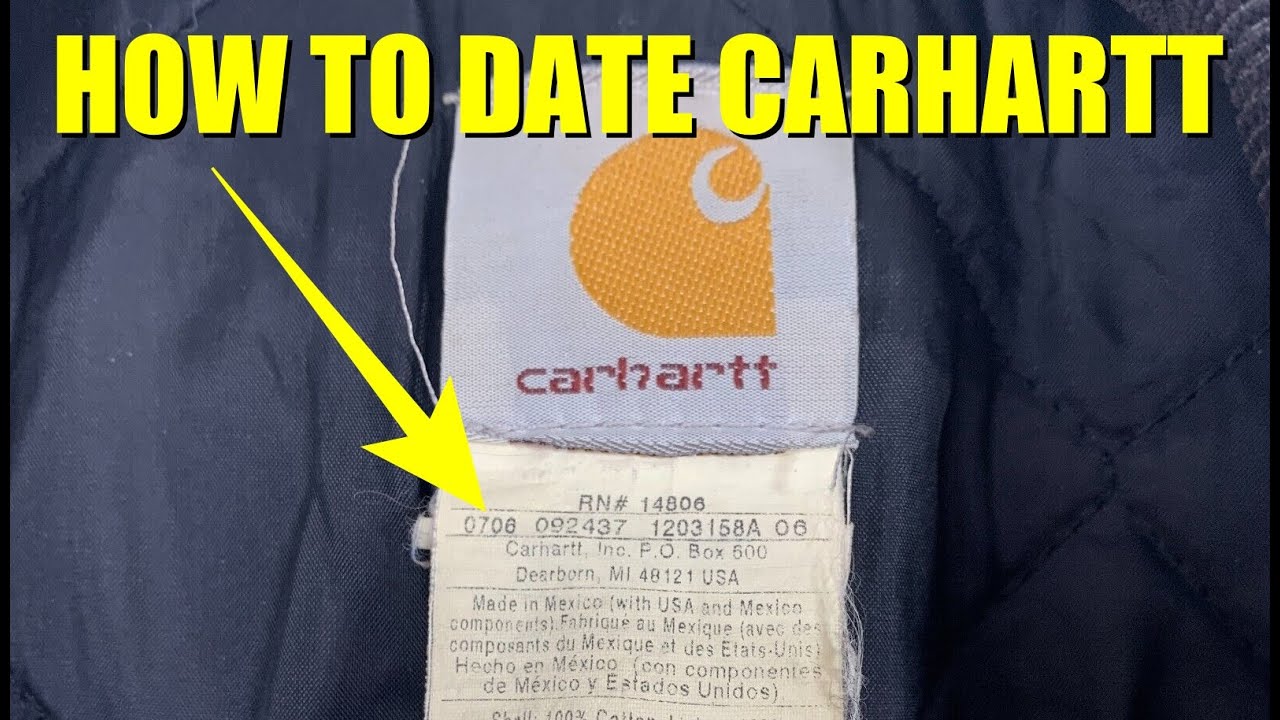
The fastest date, when it survives, is printed right on the tag. Many Carhartt care tags carry a date code of three or four digits. The last two digits are the year; the first one or two are the month.
598reads as 05/19980301reads as 03/20010205reads as 02/2005
The code is usually small and easy to miss, tucked at the top or edge of the care tag rather than on the main brand label. Not every piece has one, and on older garments it has often faded or been cut, which is exactly why the tag style and union label below matter as backups. When a code is present, it is the most precise date you will get without a receipt.
The union label: the reseller’s favourite four words
The single marker that most changes a Carhartt’s resale value is the union label: a small red-and-blue circular stamp on the tag showing the garment was built by union labor in the United States.
It is a proxy for two things buyers pay for at once: American manufacture and older production. Carhartt moved a large share of its manufacturing offshore around the turn of the 2000s, so a union stamp reliably places a piece before that shift. Pre-2000s union-labeled Carhartt in a desirable style and clean condition commands a premium over a visually identical newer import.
When you are sourcing a rack of Carhartt, the union stamp is the first thing to check. It is faster than reading a code, and it sorts the pile into ‘worth a closer look’ and ‘probably modern’ before you even find the size.
Tag material and style, decade by decade
When there is no readable date code, the tag itself dates the piece. The material and construction changed in recognisable steps.
- 1970s: a white cloth tag sewn into the neck with the Carhartt logo, and typically no model number. Look for a printed circular union stamp on the label.
- 1980s-1990s: a blocky logo with a clear Made in USA stamp and the union label. This is the sweet spot era for most collectors.
- Late 1990s-2000s: a durable white vinyl tag, sewn at the lower hem or in the neck, now carrying exact style codes (for example J97 or J01) and fabric codes (like BRN or BLK).
The move to vinyl tags with printed style and fabric codes is a useful boundary: a vinyl tag with a J-code is late-1990s or newer, not a 1980s piece, regardless of how worn the jacket looks.
The logo, from 1889 to the modern C
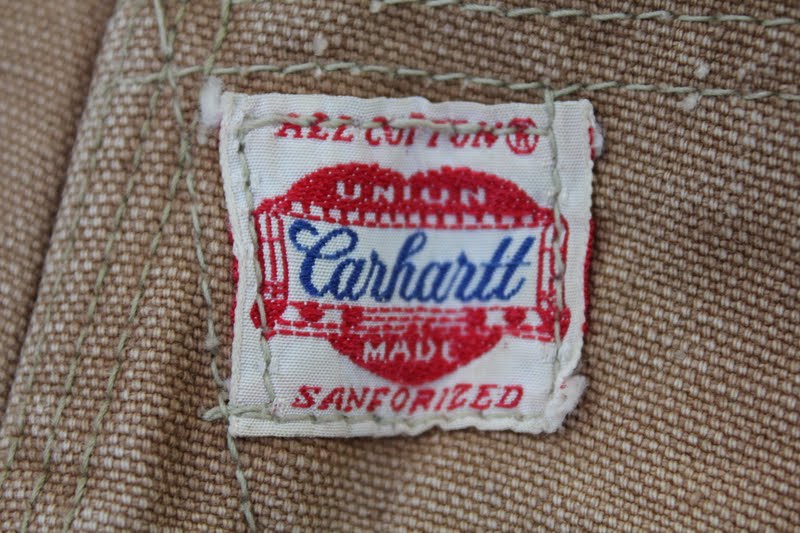
The logo helps most on genuinely old pieces. Carhartt’s earliest marks (1889 onward) combined a diamond and rectangle to signal union labor, evolving into the well-known ‘Car’ + ‘heart’ wordmark, which through the early-to-mid 1900s often carried the words Union Made inside the heart.
The modern ‘C’ logo debuted in 1966 and, on garment labels specifically, has stayed largely unchanged since 1967. That gives you a hard floor: a piece wearing the modern C label is 1966 or later. A wordmark with ‘Union Made’ script inside a heart points to a much older garment. Marketing logos varied more than garment labels, so date from the sewn-in label, not from a print on the fabric or a button.
Style and fabric codes, decoded
Once tags started carrying codes, they became a precise identifier. A style code (such as J97) names the exact garment model, and a fabric or color code (such as BLK for black or BRN for brown) names the colorway.
For a reseller, this is how you write an accurate listing and how you confirm you have what you think you have. A buyer searching for a specific model number will find a listing that includes it, and matching the style code to the garment is the cleanest way to describe a piece without guessing its name. It is also a quick authenticity sanity check: the code, the garment type, and the fabric should agree with each other.
Made in USA versus imported, and what it does to value
The Made in USA stamp, paired with the union label, is the value line for most vintage Carhartt. Older American-made pieces are what the vintage market pays up for; later imported production, even in the same silhouette, generally sells for less.
This is not a quality judgment on newer Carhartt, which is still hard-wearing workwear. It is a market fact: scarcity and provenance drive the resale premium, and ‘union-made in the USA, pre-2000s’ is the combination buyers search for. When you assess a piece, treat Made in USA plus a union stamp as the signal that you may be holding something worth more than its rack price.
Quick red flags before you buy
A few checks save you from overpaying or misdating:
- A vinyl tag with a J-style code is not a 1980s piece, no matter how faded the jacket is.
- The modern C label means 1966 or later, so do not describe such a piece as older than that.
- A cut or missing care tag removes your date code and can hide a size or origin change, so price cautiously.
- Reproductions and relabels exist, so cross-check the label, the code, and the construction against each other rather than trusting one marker alone.
Frequently asked questions
How do I read a Carhartt date code?
Find the small 3-4 digit number on the care tag. The last two digits are the year and the first one or two are the month, so 598 means May 1998 and 0301 means March 2001. Not every piece has one, and on older garments the code has often faded or been cut off.
Does the Carhartt union label mean it is valuable?
It is a strong signal. The red-and-blue circular union stamp indicates US union labor from before Carhartt’s move offshore around the 2000s, and older American-made pieces in desirable styles command a resale premium. Condition and style still decide the final price.
When did Carhartt stop making everything in the USA?
Carhartt shifted a large share of production overseas around the turn of the 2000s. There is no single clean date, which is why the union label and Made in USA stamp are used together as the practical marker for older American-made production rather than a specific year.
What does a code like J97 mean on a Carhartt tag?
That is a style code identifying the exact garment model. A separate fabric or color code, such as BLK or BRN, names the colorway. Vinyl tags carrying these codes appeared from the late 1990s onward, so their presence also helps date the piece.
How we checked this
Cross-referenced Carhartt tag, label, date-code, and union-stamp features across established vintage-identification guides and consolidated them into a single era timeline Carhartt garment-label history 1889-present, plus the 3-4 digit date-code format. Collected 2026-07-21.
What this guide does not cover
This guide covers dating from tags and labels, not full authentication of rare or high-value pieces, which can also involve construction, hardware, and stitching details. Carhartt’s label history has transitional overlaps, so treat era ranges as guides rather than exact cutoffs, and cross-check multiple markers on any piece where a lot of money is involved.
Sources
- Carhartt date code format (last two digits year, first one or two month); tag styles by era; union label; modern C logo from 1966 and largely unchanged garment labels since 1967 — Vintage Clothing Guides
- Carhartt workwear tag dating reference: white vinyl tags with style and fabric codes, union stamp, Made in USA markers — ThriftBrain