How to Sell on eBay in 2026: A Complete Beginner’s Guide
Verified 2026-07-27
You can start selling on eBay in an afternoon: create a free account, list an item, and eBay takes a fee only when it sells. The reach is enormous — eBay is one of the largest marketplaces in the world — but success depends on pricing with real data and understanding the fees before you list. This complete beginner’s guide walks through opening a seller account, choosing what to sell, writing a listing that converts, pricing from actual sold prices, shipping, and exactly what eBay’s 2026 fees are.

Key takeaways
- Creating an eBay account is free, and without a store you get 250 free listings a month, so it costs almost nothing to start.
- eBay charges a final value fee only when an item sells — around 13.6% of the total for most categories, plus a small per-order fee.
- Price from real sold listings, not active asking prices, because sold prices are what buyers have actually paid.
- Auction format suits rare or hard-to-price items; Buy It Now suits everything with a known market value.
- Most beginner losses come from underpricing shipping and from thin, poorly-photographed listings, both of which are easy to fix.
Is selling on eBay worth it?
For most people starting out, yes. eBay gives you access to a massive, buyer-ready marketplace for almost no upfront cost, and it is especially strong for exactly the things other platforms are weak at: electronics, collectibles, auto parts, tools, media, and one-of-a-kind or hard-to-find items. If it is used, niche, or vintage, eBay usually has the deepest pool of buyers searching for it.
The honest trade-off is effort and fees. eBay is competitive, and its fees — roughly 13.6% for most categories plus a per-order fee — are higher than a flat-fee app. Success comes from pricing well, photographing clearly, and shipping reliably, not from listing an item and hoping.
The biggest advantage over a social resale app is eBay’s search demand and sold-price data. People come to eBay knowing what they want, and you can see exactly what similar items have sold for before you price yours. Used well, that data is what makes eBay worth it.
What you need before you start
Setting up is quick, but have these ready:
- An eBay account (free to create; you can upgrade to a seller account during listing).
- A bank account to receive payouts, since eBay manages payments and deposits proceeds to you.
- Something to sell, ideally researched against real demand (covered below).
- Clear photos of the item — eBay lets you add up to 24, and photos are the biggest driver of clicks.
- Basic shipping supplies — a scale, boxes or mailers, and tape — so you can weigh and ship accurately.
That is genuinely all you need to open. You do not need a store subscription, a business license to start as a casual seller, or any inventory beyond your first item. eBay is one of the lowest-friction places to begin reselling.
Step 1: Create your eBay seller account
Start at eBay’s Sell page. If you already have a buying account you can sell from it; eBay will ask for a few extra details to enable payouts.
You will:
- Confirm your identity and address.
- Link a bank account for payouts — eBay’s managed payments system collects the buyer’s payment and deposits your proceeds directly, so you do not need a separate PayPal setup.
- Choose an individual or business account. Most beginners start as an individual and can switch later.
That is the whole setup. There is no monthly cost to sell as an individual, and you can list your first item immediately. If you later scale up, an eBay Store subscription (from about $21.95/month on an annual plan for the Basic tier) adds more free listings and lower fees — but you do not need one to start.
Step 2: Decide what to sell, and research demand
The single biggest predictor of a good sale is picking an item people are actually searching for. Good beginner categories on eBay include electronics and accessories, video games and media, collectibles and trading cards, brand-name clothing and shoes, tools, and parts — anything specific and searchable.
Before you commit, research demand and price using sold listings. Search the item on eBay, filter to Sold items, and you will see what real buyers paid and how quickly it moved. If similar items sell often and for a worthwhile price, it is worth listing; if nothing has sold in months, reconsider.
Start with what you have — decluttering your own home is the classic first step — and lean toward items that are easy to describe, easy to ship, and have a clear market value. Our guide to finding sold listings on eBay shows exactly how to read that data before you list.

Step 3: Create a listing that sells
A listing has two jobs: get found in search, and convince the buyer once they land. For both:
- Write a keyword-rich title. Lead with the specific terms a buyer types — brand, model, size, color, condition. "Sony WH-1000XM4 Wireless Headphones Black Noise Cancelling" beats "great headphones."
- Use the item specifics. Fill in brand, model, size, and condition fields; eBay uses them to match searches and filters.
- Photograph clearly. Use as many photo slots as you can, on a clean background, showing the item from multiple angles and any flaws. Photos drive clicks more than anything else.
- Describe honestly and completely. State condition, what is included, dimensions, and any defects. Accurate listings prevent returns and negative feedback.
A complete, honest, well-photographed listing with the right keywords is the foundation everything else builds on.

Step 4: Auction or Buy It Now, and how to price
eBay offers two formats, and choosing right matters:
- Buy It Now (fixed price) is best for the large majority of items — anything with a known market value. You set the price, and it sells when a buyer is ready. It is predictable and usually nets more.
- Auction suits genuinely rare, collectible, or hard-to-price items where you want the market to set the value. It creates urgency but can end below your hopes if few people bid.
Whichever you choose, price from real sold listings, not active asking prices. Active listings show what sellers want; sold listings show what buyers actually paid. Search your item, filter to Sold items, and price near the recent sold range, adjusting for condition. Remember to build in the roughly 13.6% final value fee and your shipping cost so your payout still works. Underpricing because you only looked at optimistic active listings is one of the most common beginner mistakes.
Step 5: Set up shipping
Shipping is where beginners most often lose money, so treat it carefully.
- Weigh and measure the packed item before you list, so you can charge accurately.
- Buy labels through eBay. eBay’s discounted shipping rates are cheaper than the counter, and buying the label in eBay adds tracking automatically — which protects you against false "item not received" claims.
- Choose calculated or flat shipping. Calculated charges the buyer based on their location and is fairest for heavier items; flat rate is simplest for small, light items.
- Consider free shipping built into the price. Buyers filter for it, and eBay favors it — just add the cost into your item price.
Ship promptly, within your stated handling time, and always with tracking. Fast, tracked shipping earns good feedback and repeat buyers.

Understand eBay’s fees before you price
Price with eBay’s fees built in, or your payout will surprise you. The core fees in 2026 are:
- Insertion (listing) fees: without a store, you get 250 free listings per month; after that it is about $0.35 per listing.
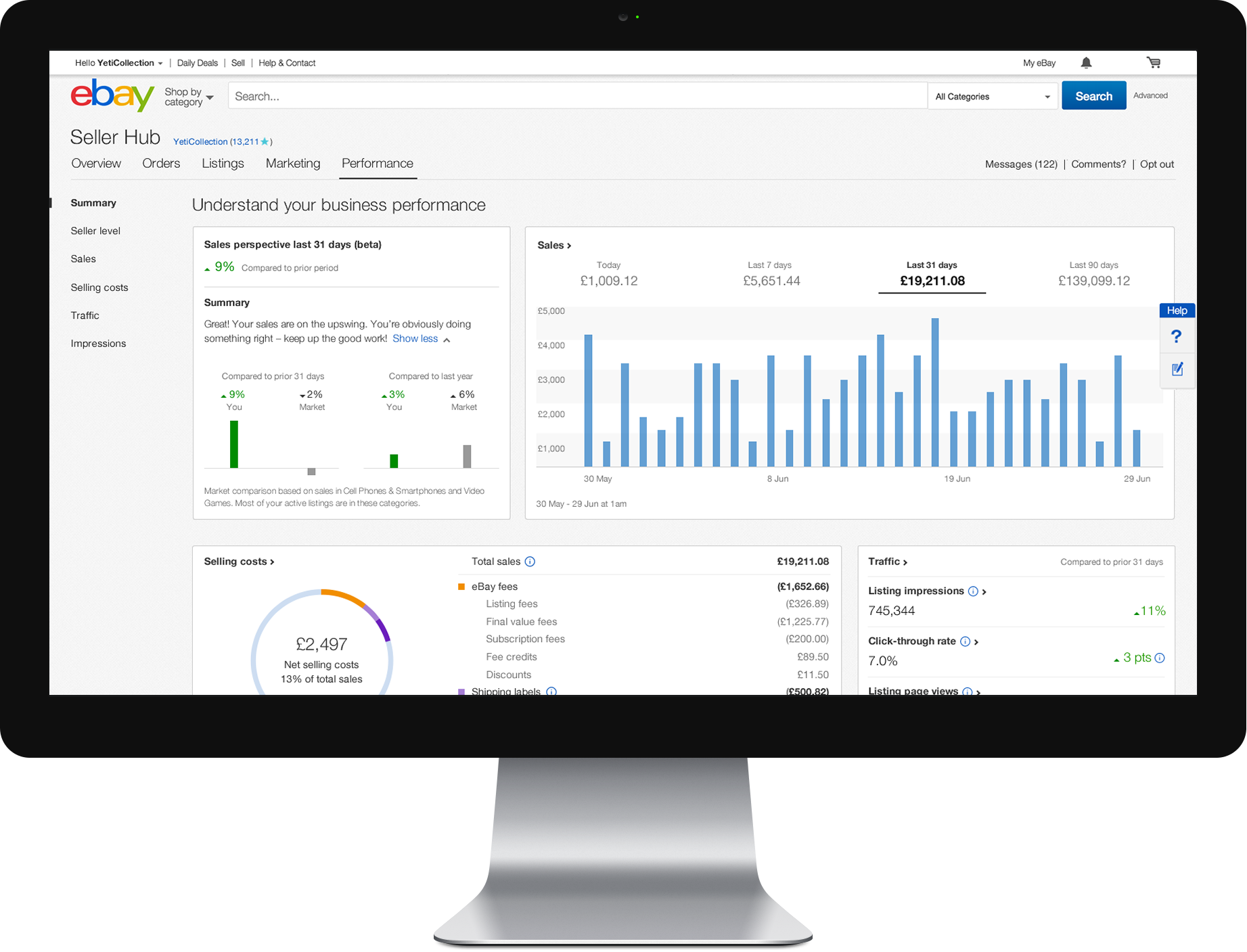
- Final value fee: eBay’s main charge, taken only when the item sells. For most categories it is around 13.6% of the total sale (item price + shipping + tax), though it varies by category (roughly 2.5% to 15%).
- Per-order fee: an additional $0.30 for orders of $10 or less, or $0.40 for orders over $10.
So on a $50 sale, expect roughly $6.80 in final value fee plus $0.40, before shipping. Optional costs include Promoted Listings (an ad fee you set) and a Store subscription if you scale. For a full breakdown with a worked example, see our dedicated guide to eBay’s selling fees.
How much does it cost to start selling on eBay?
Opening an eBay seller account is free, and without a store you get 250 free listings a month — so your only unavoidable cost is the fee eBay takes when an item sells, not before. You can list your first ten items for $0.
The real start-up costs are the ones you choose: shipping supplies (a scale, boxes, mailers, tape — often under $30 to begin), and packaging. If you are selling things you already own, that is the whole budget.
Because there is no monthly floor as an individual seller, an eBay presence costs you nothing to keep open between sales — you pay when something sells, not for existing. That makes it a low-risk place to test whether an item has a market before you invest in more inventory. A Store subscription only makes sense once you are listing in volume.
Getting your first sale and good feedback
Your first sale is mostly about trust signals, because you start with no feedback. To move faster:
- Price competitively for the first few items — being slightly under the recent sold range gets you sales and reviews.
- Over-communicate. Answer questions quickly and ship fast; buyers reward responsive new sellers.
- Nail the basics on every order — accurate description, careful packing, tracked shipping — so early feedback is positive.
- Build feedback deliberately. A handful of smooth, well-reviewed sales makes buyers comfortable, and eBay’s search rewards sellers who convert and keep buyers happy.
Good feedback compounds. The first few sales are the hardest; once you have a clean track record, buyers stop hesitating and your listings convert far more easily.

Common beginner mistakes to avoid
A few errors trip up most new eBay sellers:
- Underpricing shipping. Not weighing the item and eating the difference is the fastest way to lose money. Weigh, then charge accurately or build it into the price.
- Pricing from active listings. Active prices are wishful; only sold listings show what buyers pay. Always price from sold data.
- Thin, poorly-lit photos. Buyers cannot handle the item, so images do the selling. Use the slots and shoot clearly.
- Vague titles. Missing brand, model, or size keywords leaves you invisible in search.
- Ignoring the fees. Not building the ~13.6% final value fee into your price means a smaller payout than you expected.
Avoid those, treat it like the small business it is, and a beginner can build steady sales on eBay. The formula is not secret: real demand, honest listings, data-based pricing, accurate shipping, and fast, friendly service.
Frequently asked questions
Is it free to sell on eBay?
Creating an account is free, and without a store you get 250 free listings each month. eBay charges a final value fee only when an item sells — around 13.6% of the total for most categories, plus a per-order fee of $0.30 to $0.40. So you can list your first items for nothing and only pay when you make a sale.
How does selling on eBay work?
You create a listing (auction or fixed-price Buy It Now), a buyer purchases and pays through eBay’s managed payments, you ship the item, and eBay deposits your proceeds to your bank minus its fees. The whole payment and payout runs through eBay, which also provides tracking and seller protections.
What should I sell on eBay as a beginner?
Start with items people actively search for and that are easy to describe and ship: electronics, video games and media, collectibles, brand-name clothing, tools, and parts. Decluttering your own home is the classic first step. Always check sold listings first to confirm there is real demand and a worthwhile price.
How do I price an item on eBay?
Price from sold listings, not active asking prices. Search your item, filter to Sold items, and price near the recent sold range, adjusting for condition. Build in eBay’s roughly 13.6% final value fee and your shipping cost so your payout still works after fees.
Should I use auction or Buy It Now?
Use Buy It Now for the large majority of items — anything with a known market value — because it is predictable and usually nets more. Use auction only for genuinely rare or hard-to-price items where you want bidders to set the value. Most everyday reselling works best as fixed-price.
How much does eBay take from a sale?
For most categories, eBay’s final value fee is about 13.6% of the total sale (item price plus shipping and tax), plus a per-order fee of $0.30 for orders of $10 or less or $0.40 for orders over $10. The exact percentage varies by category, roughly between 2.5% and 15%.
What sellers are reporting
New sellers on eBay’s community boards consistently report that their most expensive early mistakes were undercharging for shipping and pricing from active listings instead of sold listings.
— sellers on the eBay Community selling board, community post
Experienced resellers repeatedly advise beginners to research sold comps before listing and to build the final value fee into pricing rather than treating it as an afterthought.
— members of the r/Flipping community, community post
What this guide does not cover
This is a general getting-started guide for selling on eBay in the US, not legal, tax, or financial advice. Fees, free-listing allowances, and store pricing change over time and vary by category, so confirm current details on eBay before relying on them. Whether your selling counts as a business for tax purposes depends on your situation.
Sources
- eBay’s final value fee is a percentage of the total sale plus a per-order fee of $0.30 for orders $10 or less and $0.40 for orders over $10, varying by category from about 2.5% to over 15%. — eBay Help
- Without a store subscription, sellers get 250 zero-insertion-fee listings per month, then about $0.35 per additional listing. — eBay Help
- Full breakdown of eBay’s fees with a worked example. — Thrift Wagon