Is Selling on Etsy Worth It in 2026? Pros, Cons & Fees
Verified 2026-08-14
Selling on Etsy is worth it if you make or sell handmade, vintage, craft, or digital products and price for its fees, because Etsy hands you a huge, ready audience of buyers looking for exactly those things. It is not worth it if you sell mass-produced resale items (which are not allowed) or want to build a long-term brand you fully control. Fees run around 11 percent plus mandatory ad fees at higher volumes, and competition is stiff. This guide covers the real math, the pros and cons, and who it fits.

Key takeaways
- Etsy is worth it mainly for handmade, vintage, craft, and digital sellers, because its audience is there to buy exactly those.
- Fees run about 11 percent per sale, plus a mandatory 12 to 15 percent Offsite Ads fee once you pass $10,000 in annual sales.
- The big advantage is a built-in audience of tens of millions of intent-driven buyers, with no monthly fee to start.
- The big drawbacks are heavy competition, fees that squeeze thin-margin products, and not owning your customers or brand.
- Digital products are the highest-margin option, since they carry no shipping or cost of goods.
The short answer
Yes, if you have the right product and price for the fees; no, if you do not.
Etsy is worth it when you sell handmade goods, vintage items (20+ years old), craft supplies, or digital products, because its audience comes specifically looking for those. You get a built-in market of tens of millions of buyers without building a website, at a low cost to start.
Etsy is not worth it when you want to resell mass-produced commercial products (which Etsy does not even allow), or when your goal is a fully owned, long-term brand with your own customer list, a case where your own store fits better.
The honest framing is that Etsy is an excellent starting point and sales channel for makers, not a magic money machine. Its fees are real, its competition is heavy, and success comes from a good product, accurate pricing, and strong listing SEO, not from simply showing up. The rest of this guide gives you the actual fee math and the trade-offs so you can decide for your situation. For what performs, see our guide to what sells on Etsy.
The real fees and margins
You cannot answer ‘is it worth it’ without the fee math, so here it is for US sellers:
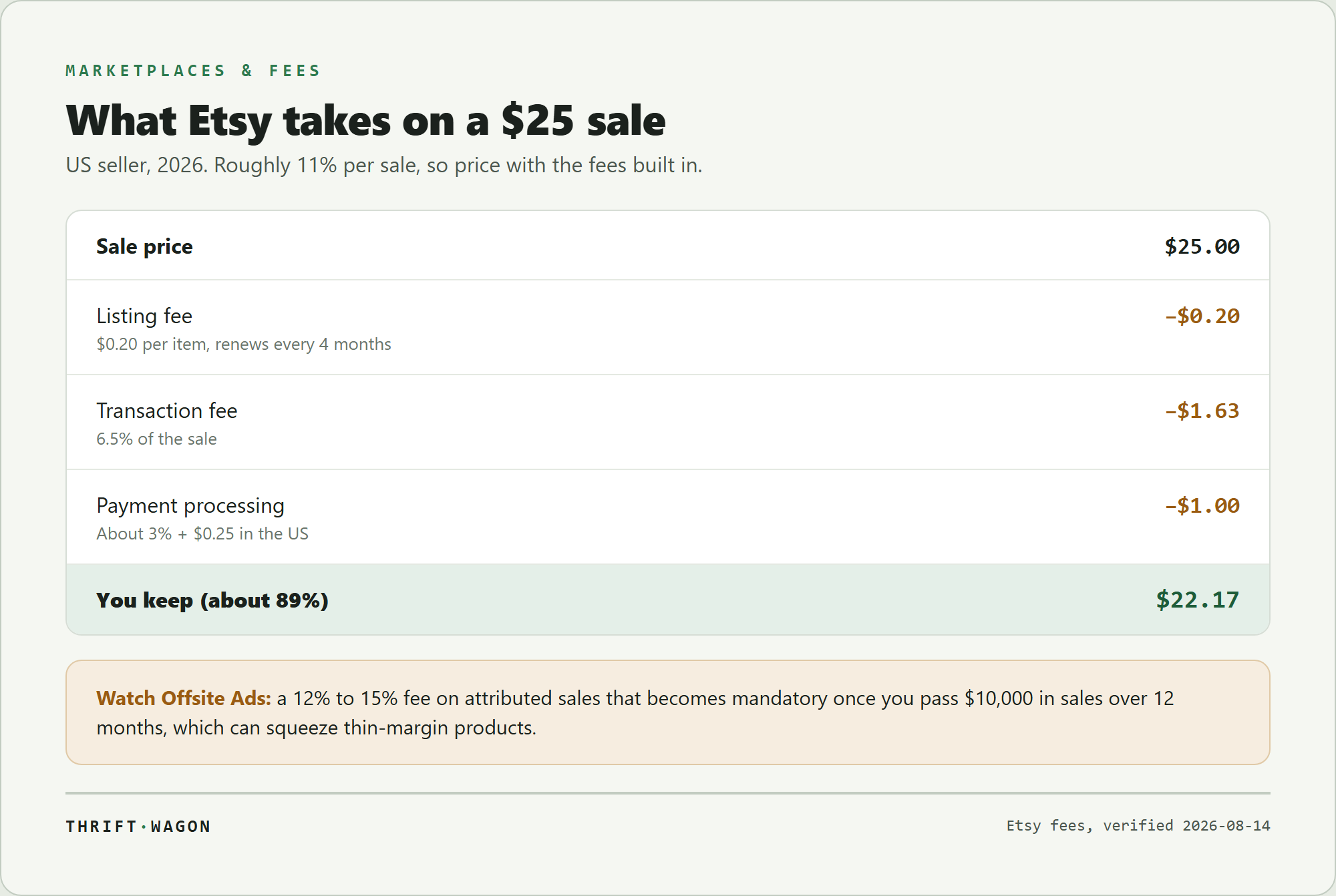
- Listing fee: $0.20 per item (renews every four months or when it sells).
- Transaction fee: 6.5% of the sale, including shipping.
- Payment processing: about 3% plus $0.25 per order.
Together these come to roughly 11% of a sale. On a $25 item, expect about $0.20 + $1.63 + $1.00 = around $2.83 in fees, leaving about $22.17.
The one that catches sellers is Offsite Ads: if Etsy advertises your item off-site and it leads to a sale, Etsy charges 12% or 15%, and this becomes mandatory once you pass $10,000 in sales over 12 months. For low-margin products (especially print-on-demand at $25 to $50), that extra fee on some sales can seriously erode profit.
So the margin verdict: Etsy is very workable for handmade and digital products with healthy markups, and tight for thin-margin resale-style goods. Price with the full ~11% (plus possible ad fees) built in from the start. For the complete breakdown, see our guide to Etsy’s seller fees.

The case for Etsy
Etsy’s advantages are real and hard to replicate elsewhere:
- A huge, built-in audience. Etsy connects millions of sellers with tens of millions of active buyers who arrive searching for handmade, vintage, and unique items. You do not have to generate your own traffic to make a first sale, which is the hardest part of an independent store.
- Low barrier and cost to start. No monthly fee (unless you add Etsy Plus), and $0.20 to list. You can test a product for almost nothing.
- Intent-driven buyers. Etsy shoppers come to buy something original and are often willing to pay for it, rather than hunting the lowest price.
- Digital products shine. Printables, templates, and downloads have no shipping or cost of goods, so they keep the highest margin, a file made once can sell repeatedly.
- Global reach and trust. Etsy’s brand and checkout carry buyer trust you would spend years building alone.
For a maker with the right product, this combination, an eager audience plus a cheap start, is exactly why Etsy is worth it. It removes the biggest obstacle (finding buyers) in exchange for its fees. To lean into the highest-margin path, see our guide to selling digital downloads on Etsy.

The case against Etsy
The drawbacks are just as real, and worth weighing honestly:
- Heavy competition. Popular niches are saturated, so standing out takes strong design, photography, and listing SEO. Simply listing is not enough.
- Fees squeeze thin margins. The ~11% base is manageable, but the mandatory Offsite Ads fee above $10,000 in sales can hurt low-margin products, and sellers regularly complain that fees have crept up over time.
- You do not own the customer or brand. Etsy keeps the customer relationship; you cannot easily market to past buyers or build a distinct brand, and you play by Etsy’s rules.
- Less control. Your storefront, policies, and even your visibility depend on Etsy’s platform and algorithm.
- Category limits. Only handmade, vintage, and craft supplies are allowed, so it is not an option for general reselling.
None of these makes Etsy a bad choice, but they explain why it is best seen as a channel, not a forever home for a brand. If long-term brand ownership is your goal, it is worth comparing Etsy with your own store, see our comparison of Etsy and Shopify.

So, is it worth it for you?
Put it together by matching Etsy to your situation:
- Worth it if you make handmade goods, sell genuine vintage or craft supplies, or create digital products, and you are ready to price for the fees and compete on quality and SEO. It is especially strong for digital sellers (highest margin) and for testing and validating a product idea cheaply.
- Not worth it if you want to resell mass-produced commercial goods (not allowed), sell very thin-margin items at scale where the fees and ad costs eat the profit, or your main goal is a fully owned brand with your own customer data.
- Consider both if you are growing: use Etsy for discovery and reach and add your own store later for repeat customers and margin, letting each do what it does best.
The bottom line: for the right product, Etsy is worth it, because it solves the hardest problem (an audience) at a low cost to start, as long as you go in clear-eyed about the fees and competition. It is a proven channel for makers, not a shortcut to easy money. For the full starting workflow, see our guide to selling on Etsy.

Frequently asked questions
Is selling on Etsy worth it in 2026?
Yes, for handmade, vintage, craft, and digital sellers who price for its fees. Etsy gives you a built-in audience of tens of millions of buyers looking for exactly those items, at a low cost to start. It is not worth it for reselling mass-produced goods (not allowed) or building a fully owned long-term brand.
How much does Etsy take per sale?
About 11 percent for US sellers: a $0.20 listing fee, a 6.5 percent transaction fee, and roughly 3 percent plus $0.25 payment processing. On a $25 item that is about $2.83 total. A mandatory Offsite Ads fee of 12 to 15 percent also applies to attributed sales once you pass $10,000 in annual sales.
Can you actually make money on Etsy?
Yes, with the right product and pricing. Handmade and especially digital products with healthy margins work well, since Etsy supplies the audience. Success depends on standing out through quality, photography, and listing SEO in competitive niches, and on pricing so the roughly 11 percent fees (plus possible ad fees) still leave a profit.
What are the downsides of selling on Etsy?
Heavy competition in popular niches, fees that squeeze thin-margin products (especially the mandatory Offsite Ads fee above $10,000 in sales), not owning your customer data or brand, less control over your storefront and visibility, and category limits, since only handmade, vintage, and craft supplies are allowed.
Is Etsy or your own website better?
They serve different goals. Etsy gives you a built-in audience and a cheap start but takes fees and keeps the customer relationship. Your own store (like Shopify) costs a monthly fee and requires you to drive traffic, but gives you full brand control and lower per-sale costs. Many sellers start on Etsy and add a store later.
What sells best on Etsy?
Handmade items, genuine vintage goods, craft supplies, and digital products like printables and templates. Digital products are the highest-margin option because they have no shipping or cost of goods. Personalized and unique items also do well, since Etsy buyers come specifically looking for original, made-to-order, and one-of-a-kind pieces.
What sellers are reporting
Etsy sellers repeatedly report that the platform is worth it for the built-in audience but that success requires standing out with strong photography and listing SEO in saturated niches, and pricing for the roughly 11 percent fees rather than expecting easy sales.
members of the r/Etsy community, community post
Print-on-demand and low-margin sellers frequently warn that the mandatory Offsite Ads fee above $10,000 in sales can seriously erode profit, and advise digital or higher-margin products to make Etsy’s fees worthwhile.
members of the r/EtsySellers community, community post
What this guide does not cover
This assesses selling on Etsy for US sellers in 2026; fees, competition, and Etsy’s programs change, so confirm current fees on Etsy before relying on the math. Whether it is worth it depends on your product, pricing, and goals. This is general guidance, not financial advice.
Sources
- Etsy charges a $0.20 listing fee, a 6.5% transaction fee, and payment processing, plus a 12 to 15% Offsite Ads fee that is mandatory above $10,000 in annual sales. (Etsy)
- Breakdown of Etsy’s seller fees and how they affect margin. (Thrift Wagon)
- What sells on Etsy and which products fit its audience. (Thrift Wagon)