eBay vs Amazon (2026): Which Should You Sell On?
Verified 2026-08-12
eBay is best for used, vintage, and one-of-a-kind items, with your own listing and low fixed costs; Amazon is best for new, branded, or commodity products sold at volume, with a huge audience and optional fulfillment. eBay charges around 13.6% per sale with no monthly fee, while Amazon charges a roughly 15% referral fee plus a per-item or monthly plan cost. The right choice depends on what you sell and how you operate. This guide compares their fees, listing models, audiences, and fulfillment, with a worked example.

Key takeaways
- eBay uses individual listings you control and is strongest for used, vintage, and collectible goods; Amazon uses a shared catalog and is strongest for new, branded, or commodity products.
- eBay charges about 13.6% plus a per-order fee with no monthly cost; Amazon charges about 15% referral plus $0.99 per item (Individual) or $39.99 a month (Professional).
- On Amazon, many sellers share one product page and compete for the Buy Box, which only Professional sellers can win; on eBay each listing stands on its own.
- Amazon offers FBA, where Amazon stores and ships your inventory, while eBay sellers usually ship themselves.
- eBay has a lower barrier to start and suits reselling; Amazon suits scaling new-product or brand businesses.
eBay vs Amazon: the short answer
Both are massive marketplaces, but they are built for different kinds of seller, so the choice is mostly about what you sell.
Choose eBay if you sell used, secondhand, vintage, collectible, or one-of-a-kind items, want your own listing that you fully control, and prefer low fixed costs and a low barrier to start. eBay is the natural home for reselling and for anything specific and searchable.
Choose Amazon if you sell new, branded, or commodity products, especially at volume, want access to the largest shopping audience and optional fulfillment (FBA), and are building a product or brand business rather than reselling odds and ends.
The two overlap least where it matters most: a used camera, a vintage jacket, or a rare card belongs on eBay; a new, barcoded product you can stock in quantity belongs on Amazon. The rest of this guide breaks down the fees, listing models, audiences, and fulfillment so you can match your inventory to the right platform.
Fees compared in 2026
The fee structures are shaped differently, so compare the whole picture, not just the headline percentage.
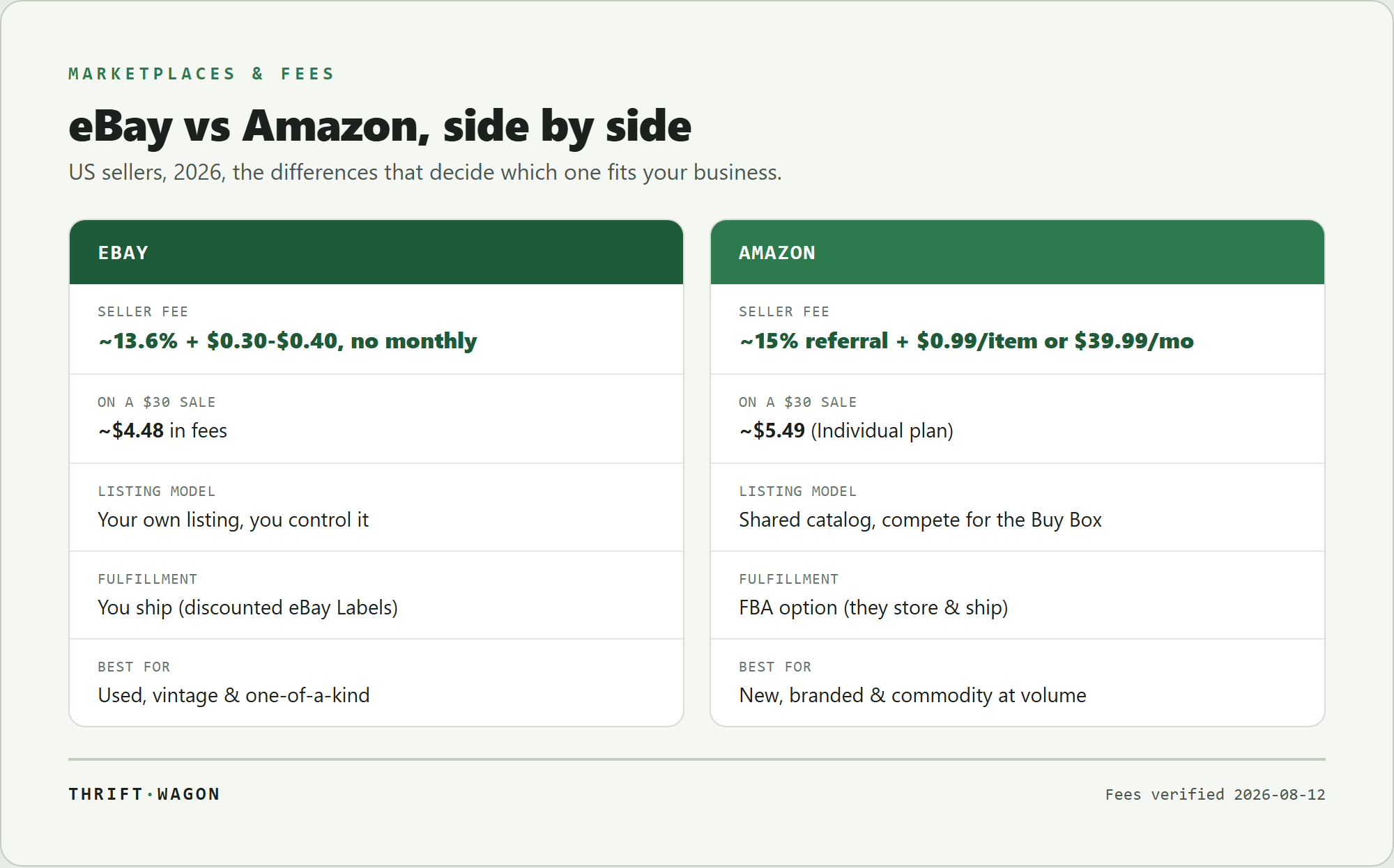
eBay charges a final value fee of around 13.6% for most categories (it varies by category) on the total including shipping, plus a per-order fee of $0.30 or $0.40. There is no monthly fee without a store subscription, and you get 250 free listings a month.
Amazon charges a referral fee on each sale, most categories around 15% (the range runs from about 5% to 45% by category), with a $0.30 minimum in most categories. On top of that you pick a plan: Individual at $0.99 per item sold, or Professional at $39.99 a month (with no per-item fee). Professional pays off past about 40 items a month.
So on a $30 sale, eBay’s fee is roughly $4.48 ($30 x 13.6% + $0.40). Amazon’s referral is about $4.50 (15%), plus $0.99 on the Individual plan (about $5.49 total) or a share of the $39.99 monthly on Professional. The percentages are close; Amazon’s extra plan cost and, if used, FBA fulfillment fees are what push its true cost higher. For eBay’s full detail, see our guide to eBay’s selling fees, and for a broad view, our marketplace fee comparison.

Listings vs catalog: a big structural difference
This is the difference new sellers underestimate, and it shapes everything.
On eBay, you create your own listing. Your title, photos, description, condition notes, and price are yours, and your listing competes on its own merits. This is ideal for used and unique items, where condition and specifics vary and there is no standard product page.
On Amazon, you list against a shared catalog. For a given product (identified by a barcode), there is usually one product page, and multiple sellers share it, competing for the Buy Box, the default ‘Add to Cart’ seller. Only Professional sellers can win the Buy Box, and it is decided by price, fulfillment, and seller metrics. This suits new, standardized products but is a poor fit for anything used or one-of-a-kind, which often has no catalog entry at all.
The practical implication: if your item is unique or used, eBay’s listing model lets you describe and price it properly. If your item is a new, barcoded product, Amazon’s catalog puts you in front of huge demand, but you compete on price and metrics for the Buy Box rather than on a listing you control.

Audience and fulfillment
Audience. Amazon has the larger overall shopping audience and buyers with high purchase intent for new products, they arrive ready to buy and expect fast, Prime-style delivery. eBay has a large, search-driven audience that is unmatched for used, niche, and collectible goods that buyers hunt for by name. Neither is ‘bigger is better,’ reach only helps if those buyers want what you sell.
Fulfillment. This is a major operational split:
- Amazon offers FBA (Fulfillment by Amazon). You send inventory to Amazon’s warehouses, and Amazon stores, picks, packs, ships, and handles returns, making your items Prime-eligible. It adds storage and fulfillment fees but removes the logistics work and boosts Buy Box odds.
- eBay sellers usually ship themselves, using discounted eBay Labels. There is no equivalent nationwide fulfillment network built in, though it keeps costs simple and predictable.
So Amazon can run closer to hands-off at scale (at a cost), while eBay is more hands-on but cheaper and simpler per sale. If shipping every order yourself is the bottleneck, FBA is a real advantage; if you sell low volume or unique items, self-shipping on eBay is fine. See how to ship on eBay for that side.

Which should you choose?
Match the platform to your product and how you want to operate:
- Choose eBay for used, secondhand, vintage, collectible, or one-of-a-kind items, for reselling, and when you want low fixed costs, your own listings, and a low barrier to start. It is also better for auctions and hard-to-price rarities.
- Choose Amazon for new, branded, or commodity products sold at volume, when you want the largest new-product audience and optional FBA fulfillment, and you are building a product or brand business.
- Use both if your business spans both: many sellers run new inventory on Amazon (often FBA) and use eBay for used, open-box, returns, and unique stock.
The summary: eBay is the reseller’s and one-off seller’s marketplace; Amazon is the new-product and brand marketplace at scale. Fees are broadly comparable per sale, so decide on fit, your inventory type, your volume, and whether you want to control listings (eBay) or tap a catalog and fulfillment network (Amazon). For where individual items earn most across platforms, see our marketplace fee comparison.

Frequently asked questions
Is eBay or Amazon better for selling?
It depends on what you sell. eBay is better for used, vintage, collectible, and one-of-a-kind items, with your own listings and low fixed costs. Amazon is better for new, branded, or commodity products at volume, with the largest audience and optional FBA fulfillment. Match your inventory type to the platform built for it.
Is eBay or Amazon cheaper to sell on?
They are close per sale. eBay charges about 13.6% plus a $0.30 to $0.40 per-order fee and no monthly cost. Amazon charges about 15% referral plus either $0.99 per item (Individual) or $39.99 a month (Professional). Amazon’s plan cost and FBA fees, if used, make its true cost higher for many sellers.
What is the difference between eBay and Amazon?
eBay uses individual listings you create and control, ideal for used and unique goods. Amazon uses a shared catalog where sellers compete for the Buy Box on one product page, ideal for new, standardized products. Amazon also offers FBA fulfillment, while eBay sellers usually ship orders themselves.
Should I sell used items on Amazon or eBay?
eBay, in most cases. Used, vintage, and one-of-a-kind items fit eBay’s listing model, where you describe condition and set your own price. Amazon’s catalog is built around new, barcoded products and often has no entry for a unique used item, and used selling there is more restricted.
What is the Buy Box on Amazon?
The Buy Box is the default Add to Cart seller on a shared Amazon product page where several sellers offer the same item. Only Professional-plan sellers are eligible, and it is won based on price, fulfillment method, and seller performance. eBay has no equivalent, since each listing is its own page.
Can I sell on both eBay and Amazon?
Yes, and many sellers do. A common setup is to sell new inventory on Amazon, often via FBA, and use eBay for used, open-box, returned, or unique items that do not fit Amazon’s catalog. Running both lets you match each product to the marketplace whose model and audience suit it best.
What sellers are reporting
Sellers who use both repeatedly explain that eBay suits used, unique, and low-volume items because you control the listing, while Amazon suits new, barcoded products at volume where you compete for the Buy Box on a shared page.
members of the r/Flipping community, community post
Amazon sellers frequently note that FBA fees and monthly plan costs make Amazon’s true cost higher than its headline referral fee suggests, and advise modeling total cost before moving inventory from eBay.
members of the r/AmazonSeller community, community post
What this guide does not cover
This compares eBay and Amazon for US sellers in 2026; fees, plans, and fulfillment costs change and vary by category, so confirm current details on each platform. Amazon FBA fees in particular depend on size and weight and are not fully covered here. This is general guidance, not financial advice.
Sources
- eBay’s final value fee is around 13.6% for most categories plus a per-order fee of $0.30 or $0.40, with 250 free listings a month. (eBay Help)
- Amazon offers an Individual plan at $0.99 per item and a Professional plan at $39.99 a month, plus referral fees that vary by category (commonly around 15%) with a minimum per item. (Amazon)
- Marketplace fee comparison across eBay, Poshmark, Etsy, Mercari, and Depop. (Thrift Wagon)