What Sells Best on Poshmark? 7,961 Sold Listings
Verified 2026-10-08
Almost every list of best selling Poshmark brands is written from memory and cites nothing. So we collected our own data: 7,961 sold Poshmark listings across 24 brands, read from Poshmark’s own sold-listing results on 8 October 2026. The short answer is that Gucci and Louis Vuitton pay the most per sale, Vuori and Alo Yoga hold their value best, and lululemon is not the top earner on either measure. Here is the full table, the method, and the honest limits of what a sold-price sample can tell you.
Key takeaways
- In our sample, 16 of the 24 brands had a median sold price under $30, and only three cleared $50.
- Vuori recovered the highest share of its stated retail price at 46%, ahead of Alo Yoga and Gucci at 42%.
- lululemon’s median sold price was $29, about 32% of stated retail, behind both Vuori and Alo Yoga on value retention.
- Michael Kors retained the least value at 23% of stated retail, followed by Nike at 24%.
- Any Poshmark sale below $14.75 costs more than 20% in commission, because the flat $2.95 fee on sales under $15 is a bigger bite than the 20% rate above it.
How we measured this
We did not survey opinions or repeat other blogs. We read Poshmark’s own sold listings.
Method. For each of 24 brands we requested Poshmark’s search results filtered to sold listings in the Women’s department, and walked 8 result pages per brand. For every listing returned we recorded the sold price and the original retail price the seller entered.
Validation. Every listing was checked twice before its price was kept: the listing’s brand field had to match the brand we requested, and its inventory status had to read sold_out. That check discarded 48 listings for brand mismatch. None failed the sold check.
Sample. 7,961 sold listings, collected on 2026-10-08. Per brand the sample ran from 271 to 379 listings, so no brand’s figure rests on a handful of sales.
What each number means. The median sold price is the midpoint of what items actually sold for. The retail figure is the median seller-stated original price. The retention percentage is the median of each item’s sold price divided by its own stated retail.
That last definition carries the main caveat, and we would rather put it at the top than bury it: original retail on Poshmark is typed in by the seller and is not verified against the brand’s real price. Treat retention as the share of the retail price sellers claimed, which is the number buyers see when they judge a deal.
The median Poshmark sale is smaller than you think
The headline finding is about scale, not brands.
16 of the 24 brands we sampled had a median sold price under $30. Only three cleared $50: Gucci at $270, Louis Vuitton at $200, and Reformation at $60.
That reframes the usual advice. Lists of best selling brands imply a closet full of $80 sales. The reality of the middle of this marketplace is a $20 to $30 item, sold to someone looking for a specific thing at a discount.
It also explains why volume sellers talk about listing counts rather than hero items. If your median sale is $25 and Poshmark takes 20%, each sale nets about $20 before the cost of the item and your time. Getting to real money means many of those, or deliberately moving up the price ladder.
The practical consequence for sourcing: the price you pay matters more than the brand on the label. A $29 median lululemon sale is a good flip at $4 and a bad one at $20, and the brand name does nothing to change that arithmetic.
Which brands hold their value best on Poshmark?
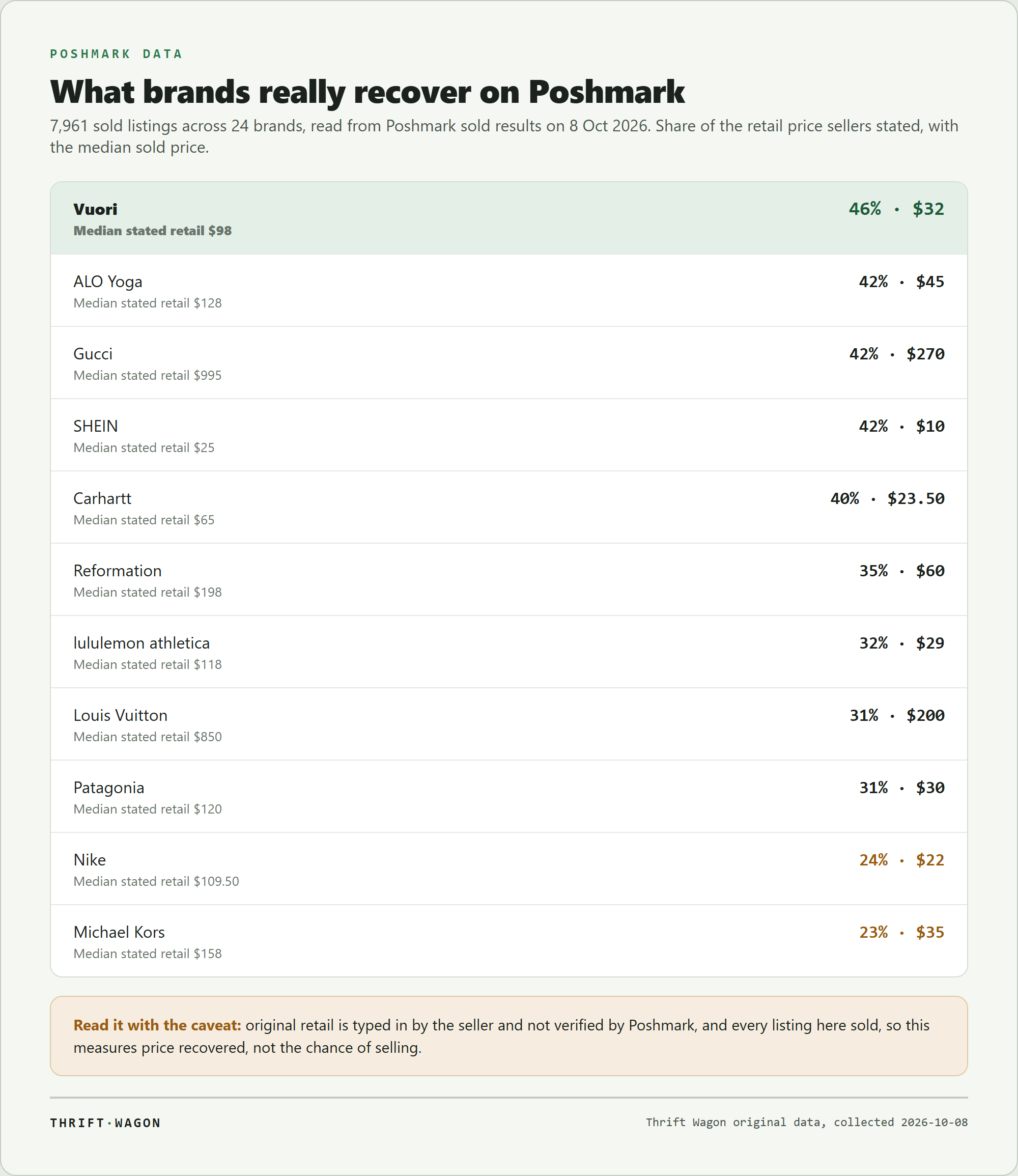
Ranked by the share of stated retail that the median item recovered:
| Brand | Retained | Median sold | Median stated retail |
|---|---|---|---|
| Vuori | 46% | $32.00 | $98 |
| ALO Yoga | 42% | $45.00 | $128 |
| SHEIN | 42% | $10.00 | $25 |
| Gucci | 42% | $270.00 | $995 |
| Carhartt | 40% | $23.50 | $65 |
| Forever 21 | 38% | $11.00 | $29 |
| Zara | 35% | $26.00 | $76.50 |
| Reformation | 35% | $60.00 | $198 |
| Levi’s | 34% | $22.00 | $75 |
| lululemon athletica | 32% | $29.00 | $118 |
| Old Navy | 32% | $13.00 | $35 |
| Torrid | 32% | $18.00 | $59 |
| Louis Vuitton | 31% | $200.00 | $850 |
| Patagonia | 31% | $30.00 | $120 |
| Coach | 30% | $41.50 | $250 |
| Spanx | 30% | $26.00 | $98 |
| Athleta | 28% | $20.00 | $89 |
| American Eagle | 28% | $15.00 | $54 |
| Free People | 27% | $25.00 | $100 |
| Anthropologie | 26% | $28.00 | $129 |
| Zyia Active | 26% | $14.00 | $59 |
| Madewell | 25% | $24.00 | $126.50 |
| Nike | 24% | $22.00 | $109.50 |
| Michael Kors | 23% | $35.00 | $158 |
The spread is narrower than the discourse suggests: every brand we sampled landed between 23% and 46%. Nothing in this set routinely resells for most of its retail price, and nothing collapses to nothing either.
Which brands pay the most per sale?
Retention percentages are useful for pricing. Dollars per sale are what actually pay you. Ranked by median sold price:
- Gucci, $270 (middle half of sales $135 to $585)
- Louis Vuitton, $200 ($55 to $499)
- Reformation, $60 ($39 to $99)
- ALO Yoga, $45 ($26 to $70)
- Coach, $41.50 ($22 to $75)
- Michael Kors, $35 ($20 to $54)
- Vuori, $32 ($25 to $47)
- Patagonia, $30 ($20 to $45)
- lululemon athletica, $29 ($20 to $45)
- Anthropologie, $28 ($20 to $44)
The two lists disagree, and that disagreement is the useful part.
SHEIN retained 42% of stated retail, which sounds excellent until you notice the median sale was $10. Michael Kors retained 23%, the worst in the sample, yet its median sale was $35, higher than lululemon’s.
So retention tells you whether buyers see your price as fair. Dollars tell you whether the sale was worth packing a box for. A sourcing decision needs both: a high retention rate on a cheap item is a hobby, and a low retention rate on an expensive item can still be a good flip if you bought it right.
The lululemon assumption, tested
lululemon is the brand most often named as the thing to source for Poshmark. Our sample does not support it being the top of the market on either measure.
- Median sold price: $29. Behind Alo Yoga ($45), Coach ($41.50), Michael Kors ($35), and Vuori ($32).
- Retention: 32% of stated retail. Behind Vuori (46%), Alo Yoga (42%), Carhartt (40%), Zara (35%), and Reformation (35%).
- Middle half of sales: $20 to $45. A consistent band, but not a lucrative one.
What the data does support is that lululemon is liquid and predictable. With 337 sold listings sampled and a tight interquartile range, it behaves like a commodity: easy to price, easy to move, little upside surprise.
That is a genuinely useful property. It is just a different claim from "lululemon makes the most money." If you buy lululemon leggings at thrift prices, the $20 to $45 band is reliable profit. If you buy them at $25 hoping for $80, the sold data says you will be disappointed, and our guide on how to find what items really sold for applies the same discipline on eBay.
Activewear: the newcomers beat the incumbents
The clearest pattern in the data is inside activewear, where the challenger brands outperform the established ones on value retention.
| Brand | Retained | Median sold |
|---|---|---|
| Vuori | 46% | $32.00 |
| ALO Yoga | 42% | $45.00 |
| lululemon athletica | 32% | $29.00 |
| Athleta | 28% | $20.00 |
| Zyia Active | 26% | $14.00 |
Vuori and Alo Yoga sit 10 to 18 points above lululemon and Athleta. Alo Yoga also carries the highest median sale of any non-luxury brand in the whole sample at $45.
A plausible reading is supply. lululemon and Athleta have been bought in volume for a decade and the secondhand market is deep, which caps prices. Vuori and Alo are newer, so there is simply less used stock chasing the same buyers.
If that is the mechanism, the advantage is temporary and will compress as more of it reaches the resale market. We would rather flag that as a hypothesis than dress it up: our data shows the gap, not the cause. Zyia Active is the cautionary case at the other end, with a $14 median sale and 26% retention, a multi-level-marketing brand whose retail price does not survive contact with resale.
Luxury on Poshmark: Gucci and Louis Vuitton
Luxury is where the dollars are, and the two big names behave differently.
- Gucci: $270 median, 42% retained, middle half $135 to $585.
- Louis Vuitton: $200 median, 31% retained, middle half $55 to $499.
Gucci held value noticeably better in our sample, tying with Alo Yoga and SHEIN at the top of the retention table. Louis Vuitton’s wider and lower spread, starting at $55 for the bottom quartile, suggests a long tail of small accessories, heavily worn pieces, and items buyers are not confident about.
That lack of confidence is the thing to design around. Authentication is the entire game in luxury resale: a buyer deciding between two $300 bags is really deciding which seller they believe. Poshmark runs its own authentication service for higher value items, and on other platforms the equivalent is eBay’s programme, which we cover in our guide to the eBay Authenticity Guarantee.
The honest trade-off for a reseller: luxury multiplies both the margin and the risk. One $270 sale beats ten $27 sales for the same packing effort, and one authentication failure or counterfeit claim erases several of them.
Fast fashion: a high percentage of almost nothing
The fast fashion result is the best illustration of why a single metric misleads.
| Brand | Retained | Median sold | Stated retail |
|---|---|---|---|
| SHEIN | 42% | $10.00 | $25 |
| Forever 21 | 38% | $11.00 | $29 |
| Old Navy | 32% | $13.00 | $35 |
| American Eagle | 28% | $15.00 | $54 |
SHEIN’s 42% retention matches Gucci’s. The difference is that 42% of $25 is $10.
Then the fee structure does the rest of the damage. Poshmark charges a flat $2.95 commission on sales under $15, and 20% on sales of $15 or more. On a $10 sale the flat fee is 29.5% of the price, so a SHEIN item nets about $7.05 before shipping supplies, the cost of the garment, and your time.
The crossover point is worth memorising: $14.75. Below that, the flat $2.95 takes a bigger share than the 20% rate does above it. Three of the four brands above have median sales below it.
None of this means fast fashion cannot work. Bundles are the mechanism that makes it work, because several cheap items shipped together share one shipping fee and can clear the $15 threshold as a single order.
Where Poshmark’s fees change the answer
Running the verified fee structure across our median prices changes which brands look attractive.
| Brand | Median sold | Commission | You keep |
|---|---|---|---|
| Gucci | $270.00 | 20% ($54.00) | $216.00 |
| ALO Yoga | $45.00 | 20% ($9.00) | $36.00 |
| Vuori | $32.00 | 20% ($6.40) | $25.60 |
| lululemon | $29.00 | 20% ($5.80) | $23.20 |
| Old Navy | $13.00 | $2.95 flat | $10.05 |
| SHEIN | $10.00 | $2.95 flat | $7.05 |
Two things follow for sourcing.
First, the gap between brands widens after fees, because a percentage fee preserves ranking while the flat fee punishes the cheapest items hardest.
Second, pricing just above $15 is a trap worth knowing about. At $15.00 the commission jumps from $2.95 to $3.00, which is trivial. But at $16 you keep $12.80, while at $14.50 you keep $11.55. The threshold is not a cliff, it is just a reminder that the cheapest third of listings carry the heaviest effective rate.
One more cost to note: Poshmark states that as of 1 October 2025, sellers located in Texas see an additional Texas Seller Fee Tax deducted from their earnings. Our full breakdown of platform costs is in what each marketplace charges sellers.

The brands that lose the most value
The bottom of the retention table is as instructive as the top.
- Michael Kors, 23%. A $158 stated retail becomes a $35 sale.
- Nike, 24%. A $109.50 stated retail becomes a $22 sale.
- Madewell, 25%. $126.50 becomes $24.
- Zyia Active, 26%. $59 becomes $14.
- Anthropologie, 26%. $129 becomes $28.
Two different stories sit in that list.
Michael Kors and Nike are volume brands. Both are sold everywhere, discounted constantly at retail, and present in enormous quantity secondhand. 363 and 337 sold listings respectively in our sample. Deep supply means buyers can always find another one, and that caps the price.
Anthropologie and Madewell are the more interesting case, because both are well regarded brands whose buyers nonetheless expect a steep discount. A $129 dress selling for $28 is not a weak brand, it is a brand whose retail price was never what customers believed it was worth.
For sourcing, low retention is not automatically disqualifying. Nike at 24% still produces a $22 median sale, which is fine if the item cost you $3. What low retention does rule out is paying anywhere near retail and expecting resale to rescue it.
What this data cannot tell you
We would rather state the limits than let the numbers be read as more than they are.
It does not measure sell-through. Every listing in our sample sold, by construction. So this tells you what sold items went for, not what share of listed items sell, or how long they took. A brand could have an excellent median price and a terrible chance of selling at all, and this dataset would not show it. That is the single biggest gap, and anyone claiming a sell-through rate should tell you how they measured it.
Retail prices are seller-entered. Poshmark does not verify the original price field, so retention rates are relative to what sellers claimed, not to verified MSRP. Inflated retail prices would depress retention figures.
It is not a random sample. We walked 8 pages of Poshmark’s own sold results per brand, in Poshmark’s ordering, in the Women’s department. It is a cross-section of what Poshmark surfaces, and sold dates in the sample ranged from 2013 to the day of collection, so it is not a 90 day window.
It is 24 brands, not the market. We chose brands that are commonly recommended, plus a few controls. Absence from our table means we did not test it.
It says nothing about condition, size, or season, all of which move prices inside any brand.
So what should you actually source for Poshmark?
Our data points to a simple framework rather than a shopping list.
- Buy for the gap, not the logo. Every brand we tested resold between 23% and 46% of stated retail. The brand barely moves that range, so your profit comes from what you paid.
- Prefer $25 and up where you can. Below $14.75 the flat commission takes nearly 30%, and the work per order is the same as on a $270 bag.
- Activewear is the strongest non-luxury category, and the newer names (Vuori at 46%, Alo at 42%) beat the established ones. Treat that advantage as temporary.
- Use lululemon for liquidity, not upside. A predictable $20 to $45 band is useful, so long as you bought cheap.
- Move up to luxury only with authentication discipline. Gucci’s $270 median is the best dollar-per-box figure in our sample, and the risk is proportional.
- Bundle cheap items. It is the only way fast fashion escapes the flat fee and the shipping cost.
And re-run the check yourself before a big buy. These are our numbers from one day in October 2026, on 24 brands, in one department. The method is more durable than the table: filter Poshmark to sold listings, read the real prices, and ignore anyone who publishes a best brands list without one. If you are new to the platform, start with our guide on how to sell on Poshmark.
Frequently asked questions
What brand sells for the most on Poshmark?
In our sample of 7,961 sold listings, Gucci had the highest median sold price at $270, followed by Louis Vuitton at $200 and Reformation at $60. Outside luxury, Alo Yoga led at a $45 median. Note that this measures what sold items went for, not how likely an item is to sell.
Which brands hold their value best on Poshmark?
Vuori retained the most at 46% of its stated retail price, followed by Alo Yoga, SHEIN, and Gucci at 42%, then Carhartt at 40%. Every one of the 24 brands we sampled landed between 23% and 46%, so no brand in the set reliably resells for most of its original price.
Is lululemon still worth selling on Poshmark?
Yes, if you source it cheaply. lululemon’s median sold price was $29 and it retained about 32% of stated retail, behind Vuori and Alo Yoga on both measures. Its strength is predictability: a tight $20 to $45 middle range makes it easy to price and quick to move.
What does Poshmark take from a sale?
Poshmark charges a flat $2.95 commission on sales under $15, and 20% on sales of $15 or more. That means any sale below $14.75 costs more than 20% in commission. Poshmark also notes that since 1 October 2025, sellers located in Texas see an additional Texas Seller Fee Tax deducted.
Does fast fashion sell on Poshmark?
It sells, but the economics are thin. SHEIN retained 42% of stated retail in our sample, the same share as Gucci, yet the median sale was $10, which nets about $7.05 after the flat commission. Bundling several items into one order is the practical way to make cheap brands viable.
How can I check what sells on Poshmark myself?
Filter Poshmark’s search to sold listings and read the actual prices for the brand, item type, and condition you are considering, rather than the asking prices of active listings. That is exactly what our dataset is: Poshmark’s own sold results, read brand by brand and validated as sold before counting.
How we checked this
Poshmark search results filtered to sold listings in the Women’s department, read directly from Poshmark’s own page data, 8 result pages per brand. Each listing was kept only if its brand field matched the requested brand and its inventory status was sold_out; 48 listings were discarded for brand mismatch. Sold price and seller-entered original retail price were recorded per listing, and medians, quartiles, and per-item sold-to-retail ratios were computed per brand. 7,961 sold listings across 24 brands, 271 to 379 listings per brand. Collected 2026-10-08.
What sellers are reporting
Resellers repeatedly report that sourcing price, not brand, decides whether a Poshmark flip is profitable, and that cheap fast fashion items are rarely worth listing individually once the flat commission and shipping are counted.
members of the r/poshmark community, community post
Sellers frequently describe lululemon as a fast and predictable mover rather than a high-margin brand, and advise pricing it from recent sold listings instead of from retail price.
members of the r/Flipping community, community post
What this guide does not cover
This analysis covers sold-listing prices for 24 brands in Poshmark’s Women’s department, sampled on 8 October 2026. It does not measure sell-through rate, time to sell, or seasonality, and the original retail prices it compares against are entered by sellers rather than verified. It is not investment or business advice, and resale prices change.
Sources
- Poshmark takes a flat commission of $2.95 for sales under $15, and 20% for sales of $15 or more, with the seller keeping 80%. (Poshmark Support)
- As of 1 October 2025, sellers located in Texas see an additional Texas Seller Fee Tax deducted from their earnings. (Poshmark Support)
- Poshmark search can be filtered to sold listings, which is the source of the sold prices analysed here. (Poshmark)