How Does Bidding Work on eBay? 2026 Auction Guide
Verified 2026-10-08
eBay bidding is automatic: you enter the highest amount you are willing to pay, and eBay places bids for you up to that limit instead of making you sit and click. That one design choice explains almost everything else about eBay auctions, including why your bid can rise without you touching anything, why a winning bid is legally binding, and why you can almost never take a bid back. This guide covers how proxy bidding works, what happens in the final seconds, and the only two reasons eBay accepts for retracting a bid.

Key takeaways
- You enter a maximum bid and eBay bids on your behalf up to that limit, so your displayed bid can climb while you are offline.
- A bid is a binding contract. If you win, you are committing to buy the item.
- eBay accepts only two reasons for retracting a bid: you typed the wrong amount, or the seller significantly changed the item description.
- When a listing is ending in less than 12 hours, a retraction is only possible within 1 hour of placing that bid, and bids on Trading Cards cannot be retracted at all.
- eBay is testing extended bidding in some categories, where any bid in the final 60 seconds resets the clock to 60 seconds.
How bidding on eBay actually works
eBay runs on proxy bidding, also called automatic bidding. In eBay’s own words, when bidding on an auction you "enter the maximum bid you feel comfortable with and we’ll place bids for you, up to that limit."
That means you are not competing click by click. You tell eBay the ceiling, and eBay defends your position for you until someone goes above your ceiling.
So a typical auction looks like this:
- You find an auction listing and enter the most you would pay, say $60.
- eBay shows the current price, which may be far below $60, because it only uses as much of your maximum as it needs to stay in front.
- Another buyer bids. eBay automatically raises your bid for you, still capped at $60.
- If someone bids $61, you are outbid and eBay notifies you.
The practical consequence is that the displayed high bid is not the same as what the leader is willing to pay. Someone whose maximum is $200 can be sitting at a displayed $22 with hours still to run. This is why a price can jump sharply in the last seconds of an auction: the increase was always available, it just had not been needed yet.

What your maximum bid really means
Your maximum is private, and it is the only number that matters. eBay competes up to it on your behalf, so there is no mechanical advantage in babysitting the listing and nudging the price up manually.
Set it once, honestly
The cleanest way to use proxy bidding is to decide the highest price at which the item is still worth buying to you, enter that, and walk away. If you lose, you lost to someone who valued it above your ceiling, which is the outcome you wanted.
Why raising your maximum later feels bad
Re-entering a higher maximum after being outbid is where auction regret starts. You are no longer bidding against the item’s value to you, you are bidding against a stranger. The number you set when you were calm is almost always the better number.
Track what you have bid on
Every bid you place is listed in the Bids/Offers section of My eBay, including items you bid on but did not win. That history is useful in two ways: it tells you what you actually committed to, and the losing bids are a free record of what items in your category are really closing at.
Is a bid on eBay binding?
Yes. eBay states it plainly: "A bid is a binding contract. When you bid on an item in an auction, you’re committing to buy it if you win."
This is the single most misunderstood part of eBay auctions, and it is the reason the retraction rules in the next sections are so narrow. A bid is not an expression of interest that you can withdraw on a whim, and winning is not an invitation to decide whether you still want the thing.
The honest trade-off is that bidding is cheap and fast precisely because it is binding. Sellers accept low starting prices because the commitment is real. If bids were cancellable, every auction would need a reserve or a deposit.
What happens if you win and do not pay? The seller can cancel the order as unpaid, and unpaid cancellations go on your record. eBay explicitly lists "a history of canceled orders for not paying on time" as a reason it may limit your ability to bid. Non-payment is not a free exit, it is a slow route to losing your bidding privileges.
What happens in the last minute of an eBay auction
On a standard eBay auction, the clock is hard. The listing ends at its stated end time, and the highest maximum bid at that instant wins. That is what makes last-second bidding (sniping) effective: a bid placed with seconds left gives rival bidders no time to respond.
That may be changing. eBay says it is testing extended bidding on auction listings in some categories, where "any bid placed in the final 60 seconds resets the clock to 60 seconds."
If you are bidding in a category running that test, sniping stops working the way it used to. The auction keeps extending while bids keep arriving, so the item goes to whoever actually has the highest ceiling rather than to whoever had the fastest finger.
Either way, proxy bidding is the defence. A maximum bid entered hours early behaves identically to the same maximum entered one second before the close, because eBay is bidding it for you. The only thing you lose by bidding early is the chance to change your mind, which, given how binding bids are, you did not really have.

Can you cancel a bid on eBay?
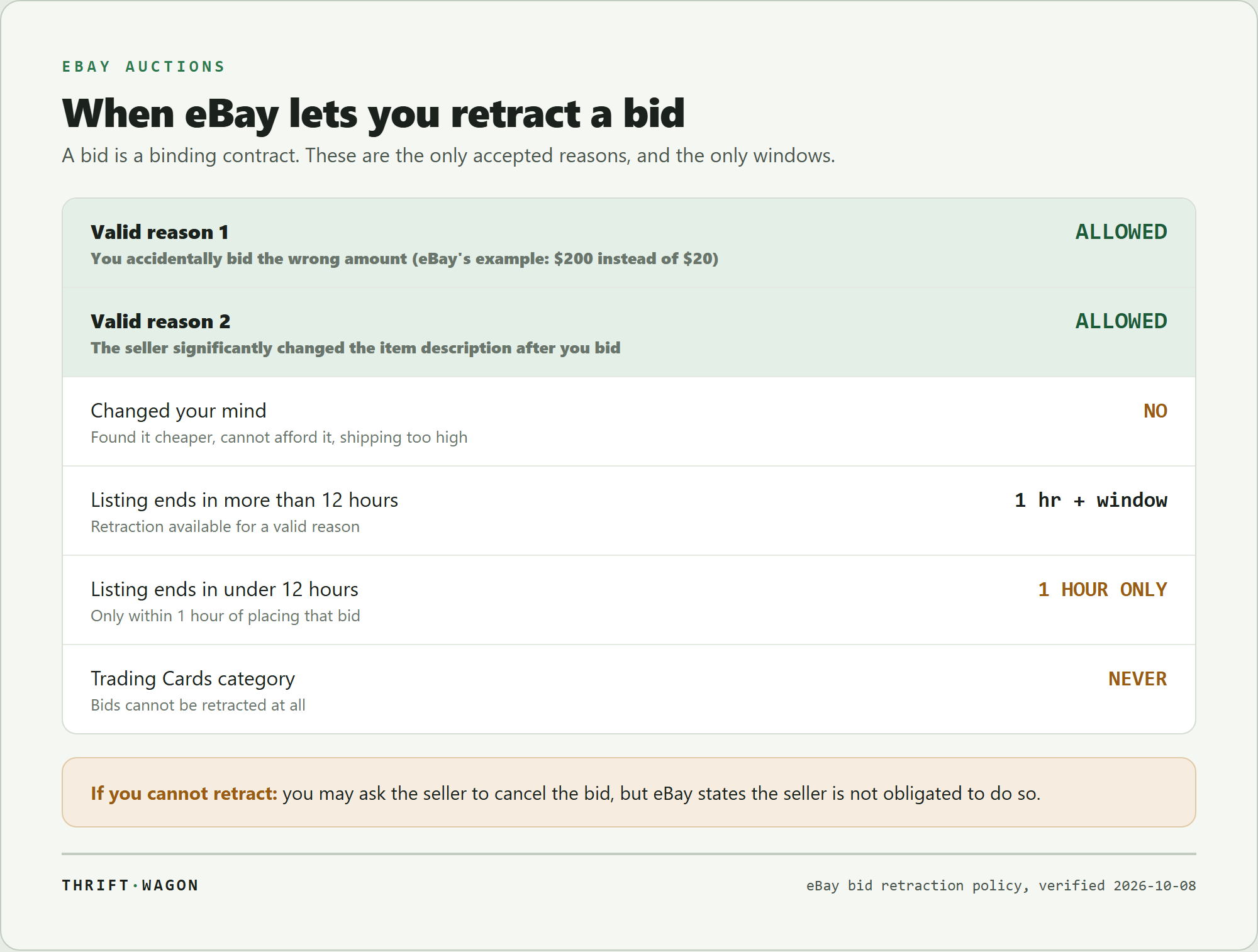
Almost never. eBay allows a bid to be retracted for exactly two reasons:
- You accidentally bid the wrong amount. eBay’s example is meaning to bid $20 and bidding $200.
- The seller significantly changed the description of the item after you bid.
That is the whole list. eBay’s policy is explicit that "any other bids can’t be retracted." Changing your mind, finding it cheaper elsewhere, realising you cannot afford it, or deciding the shipping is too high are all reasons you will not get a retraction for.
There are two further restrictions worth knowing before you bid:
- Timing. The retraction options "are only applicable for up to 1 hour after making the bid when the listing is ending in less than 12 hours." So on an auction in its final half day, you get a one hour window from the moment you bid, and nothing after that.
- Category. Bids on Trading Cards cannot be retracted at all. If you bid on a card, treat it as final the second you confirm it.

How to retract a bid, step by step
If your situation genuinely matches one of the two valid reasons, act immediately. The window is measured from when you placed the bid, not from when you noticed the problem.
- Open the listing or go to Bids/Offers in My eBay and find the bid.
- Use eBay’s bid retraction form and select the reason that applies: the wrong amount was entered, or the seller changed the item description.
- Submit it. If the option is not offered, the bid is outside the window or the category is excluded.
A typo is only a typo straight away
The wrong amount reason exists for fat-finger errors, like a missing decimal point. It is not a general escape hatch, and it is checked against timing, so a $200 bid you "meant" to be $20 is retractable in the minutes after you place it, not the evening before the auction ends.
Retractions are visible
Bid retractions are recorded against your account. A pattern of them is exactly the kind of behaviour that gets a buyer added to sellers’ blocked buyer lists, so use them for real mistakes only.
What to do when you cannot retract a bid
You have one route left: ask the seller to cancel the bid for you. eBay confirms you "may contact the seller to request bid cancellation," and is equally clear that "the seller isn’t obligated to cancel the bid."
This works more often than people expect, because a bid from a buyer who does not want the item is worth very little to a seller. An unpaid winner costs them time, a relisting, and sometimes a lower final price.
How to ask well:
- Message the seller through eBay, before the auction ends, not after you have won.
- Say what happened in one line and ask directly for the bid to be cancelled.
- Do not lie about the item being misdescribed. Sellers compare your message to their listing, and a false claim invites a report instead of a favour.
If the auction has already ended and you are the winner, you are a buyer with an order, not a bidder. At that point the options are the standard ones: ask the seller to cancel the order before they ship it, or pay. Our guide on canceling an order on eBay covers the timings for that.
Why eBay sometimes blocks you from bidding
If a bid will not go through, the block is coming from one of two places: the seller, or eBay.
Sellers can make their listings unavailable to specific bidders. eBay notes that sellers "can block buyers with low feedback scores or buyers they no longer wish to do business with," and that you will receive a notification when you try to bid on a listing you are blocked from.
eBay applies buying limits of its own. It says it may limit your ability to bid on auctions or make a Best Offer if:
- you are bidding on an expensive item
- it needs to verify your identity
- you need to add a payment method to your account
- you have a history of canceled orders for not paying on time
- you have suddenly and significantly increased your bidding and buying activity
- you have several items awaiting payment
eBay’s own advice for avoiding this is short: "the best way to avoid buyer restrictions is to pay for your items quickly." A separate and more serious state is a buying restriction, which blocks purchases entirely and is usually applied after a policy violation.
Auction, Buy It Now, or Best Offer: which format you are in
eBay sells the same item in three different ways, and the commitment rules differ.
- Auction. Timed, proxy bidding, binding on the winner. Best for items whose value is uncertain or contested, where competition sets the price.
- Buy It Now. A fixed price you can accept immediately. No bidding, no waiting, and the purchase is an order the moment you commit.
- Best Offer. You propose a price on a fixed-price listing and the seller accepts, declines, or counters. An accepted offer is binding in the same way a winning bid is, and the retraction rules are just as tight. We cover that in detail in our guide to canceling or retracting an offer on eBay.
A single listing can carry both an auction and a Buy It Now price, and the Buy It Now option disappears once bidding passes a threshold the seller does not control.
If you want the item and the price is acceptable, Buy It Now is the lower risk path. Auctions only pay off when there is genuine uncertainty about what something is worth, and that uncertainty cuts both ways.
How to bid without overpaying
Auction prices are public and historical, so there is no reason to guess what an item is worth.
Check what it has actually sold for
Filter eBay search to completed and sold listings and look at the real closing prices for the same item in the same condition, not the asking prices of what is currently live. Our walkthrough on finding sold listings on eBay shows exactly where that filter is.
Price the whole cost, not the bid
Add shipping, and add sales tax where it applies. A $40 bid with $18 shipping loses to a $52 Buy It Now with free shipping, and the auction feels like the better deal right up until checkout.
Set your maximum off the comps, then stop
If sold comps cluster at $55 delivered, your maximum is whatever leaves that intact after shipping. Enter it once.
Watch for the same item listed again
High-volume items relist constantly. Losing today usually means another chance within the week, which is the cheapest reason not to chase a bid.
Read the seller, not just the item
Feedback, return terms, and clear photos of flaws matter more on auctions, because you are committing before you can ask many questions.

What changes for payment in September 2026
eBay has flagged a change to how winning gets paid for. According to its bidding help page, starting September 2026 some buyers will see autopay options with either 24-hour or 4-day delays.
In practice that means the gap between winning an auction and the money moving can be set rather than assumed. For a buyer bidding across several auctions at once, a delay window is useful: it gives room to see which auctions you actually won before the charges land.
It does not change the commitment. Autopay affects when the payment is taken, not whether you owe it. Winning still creates an order, and not paying still risks the unpaid-order record that eBay cites as a reason for limiting bidding.
If you bid on multiple similar items hoping to win one, the safe approach is still the old one: do not place more binding bids than you can afford to win. Proxy bidding makes it easy to have five live maximums at once, and nothing stops all five from closing in your favour on the same evening.
So, how should you bid on eBay?
Treat every bid as a purchase, because that is what eBay treats it as.
The formula that works:
- Look up sold comps for the same item and condition.
- Work out your maximum delivered price, including shipping and tax.
- Enter that maximum once, early, and let proxy bidding do the work.
- Do not raise it when you are outbid.
- If you make a genuine typo, retract within the hour, and remember Trading Cards are excluded entirely.
Auctions reward patience and punish attachment. The bidder who wins well is the one who decided the number before the clock mattered, and who was content to lose at one dollar above it. If that sounds like too much discipline for an item you really want, the honest answer is to use Buy It Now and pay the certainty premium, which is usually smaller than the premium a contested auction extracts in its final sixty seconds.
Frequently asked questions
Does bidding early on eBay drive the price up?
No. eBay uses proxy bidding, so entering your maximum early does not reveal it or raise the price beyond what is needed to keep you in front. The displayed price only rises when another bidder pushes it up. Bidding early and bidding late with the same maximum produce the same result on a standard auction.
Can you cancel a bid on eBay if you change your mind?
No. eBay allows retraction only if you bid the wrong amount by accident or the seller significantly changed the item description. Changing your mind is not an accepted reason. You can ask the seller to cancel your bid, but eBay states the seller is not obligated to do so.
Can you retract a bid in the last 12 hours of an auction?
Only within one hour of placing it. eBay’s retraction options apply for up to 1 hour after making the bid when the listing is ending in less than 12 hours. After that hour, the bid stands and your only option is to ask the seller to cancel it.
Why can’t I bid on an eBay item?
Either the seller has blocked you, or eBay has placed a buying limit on your account. Sellers can exclude buyers with low feedback or buyers they no longer want to deal with. eBay may limit bidding if you have unpaid cancellations, no payment method on file, unverified identity, several items awaiting payment, or a sudden spike in activity.
What happens if I win an eBay auction and do not pay?
The seller can cancel the order as unpaid, and the cancellation is recorded against your account. eBay lists a history of canceled orders for not paying on time as a reason it may restrict your ability to bid. A winning bid is a binding commitment to buy, so non-payment is a policy problem rather than a way out.
Can bids on trading cards be retracted?
No. eBay’s bid retraction policy states that bids on Trading Cards cannot be retracted. In that category a bid is final as soon as you confirm it, regardless of the auction’s remaining time, so check the amount and the listing details carefully before you commit.
What sellers are reporting
Buyers repeatedly discover that changing your mind is not a valid retraction reason, and that the practical move is to message the seller and ask them to cancel the bid before the auction ends rather than simply not paying.
members of the r/Ebay community, community post
Sellers consistently advise new bidders that the visible high bid hides the leader’s real maximum, so a price that looks low all week can jump sharply at the close once proxy bids are tested against each other.
members of the r/eBaySellerAdvice community, community post
What this guide does not cover
This guide covers buyer-side bidding on eBay.com in the US. It does not cover eBay Live auction events, reserve price mechanics, eBay’s exact bid increment table, or seller-side auction setup, all of which are documented on eBay’s own help pages. Policies and tests such as extended bidding can change by category.
Sources
- When bidding on an auction you enter the maximum bid you are comfortable with and eBay places bids for you up to that limit. (eBay Help)
- A bid is a binding contract: bidding commits you to buy the item if you win. (eBay Help)
- eBay is testing extended bidding on auction listings in some categories, where any bid placed in the final 60 seconds resets the clock to 60 seconds. (eBay Help)
- Starting September 2026, some buyers will see autopay options with either 24-hour or 4-day delays. (eBay Help)
- Items you bid on but did not win are tracked in the Bids/Offers section of My eBay. (eBay Help)
- A bid may be retracted only if the seller significantly changed the item description or you accidentally bid the wrong amount, for example bidding $200 instead of $20. (eBay Help)
- Retraction options apply for up to 1 hour after making the bid when the listing is ending in less than 12 hours. (eBay Help)
- Bids on Trading Cards cannot be retracted, and any other bids cannot be retracted. (eBay Help)
- If retraction is not available you may contact the seller to request bid cancellation, but the seller is not obligated to cancel the bid. (eBay Help)
- Sellers can make listings unavailable to specific bidders and can block buyers with low feedback scores. (eBay Help)
- eBay may limit bidding or Best Offer if you are bidding on an expensive item, it needs to verify your identity, you need to add a payment method, you have a history of canceled orders for not paying on time, you suddenly increased buying activity, or you have several items awaiting payment. (eBay Help)
- A buying restriction prevents purchases on eBay entirely and is usually applied after a policy violation. (eBay Help)



[…] How bidding works on an eBay auction […]