Sites Like Etsy: 6 Best Alternatives for Sellers
Verified 2026-10-08
The honest answer is that Etsy’s alternatives split into two different things: other marketplaces that bring you traffic and take a cut, and your own store, which takes a smaller cut and brings you no traffic at all. Amazon Handmade is the closest marketplace swap, Shopify and Big Cartel are the store options, Gumroad handles digital products, and eBay remains the biggest search audience for vintage. This guide covers six real alternatives with the costs each platform publishes on its own site, verified in October 2026.

Key takeaways
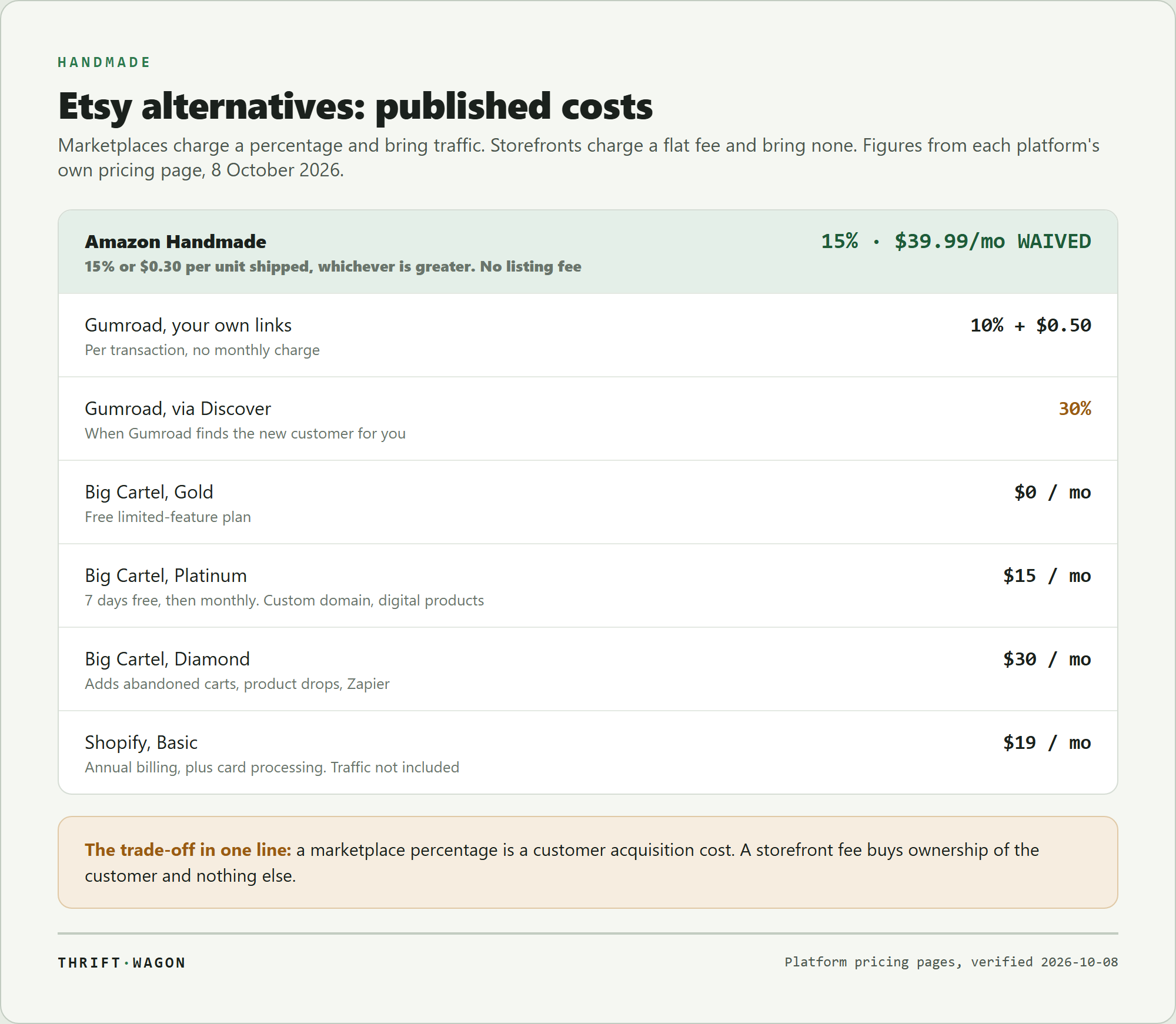
- Amazon Handmade waives the $39.99 monthly Professional selling fee and charges a referral fee of 15% or $0.30 per unit, whichever is greater.
- Big Cartel has a free limited plan, with paid plans at $15 and $30 a month and no transaction fee of its own on the paid tiers.
- Gumroad charges 10% plus $0.50 per transaction on your own links, rising to 30% when a new customer finds you through its Discover marketplace.
- Shopify starts at $19 a month on annual billing and gives you a real storefront, but sends you no traffic whatsoever.
- Marketplaces rent you an audience; your own store means you own the customer. Most established makers end up running both.
Why makers start looking past Etsy
Four complaints drive almost every search for an Etsy alternative, and they do not all have the same solution.
The costs stack. Etsy charges a listing fee, a transaction fee on the sale, and payment processing, and above an annual sales threshold its Offsite Ads programme becomes mandatory. Individually each is modest. Together, on a thin-margin handmade item, they decide whether the work is worth doing. Our breakdown of Etsy’s seller fees has the current figures.
Competition inside the category. Etsy’s audience is a genuine asset, but so is everyone else’s listing. A new shop in a saturated niche competes with thousands of established sellers with review histories.
You do not own the customer. A buyer who loves your work is Etsy’s customer. You cannot email them, and the next time they shop, Etsy decides who they see.
Policy exposure. Account suspensions, fee changes, and search algorithm shifts all land without warning on a business you do not control.
The first two complaints point to a different marketplace. The last two point to your own store, which is a different business entirely. Being clear about which problem you have prevents an expensive wrong move.
Amazon Handmade: the closest marketplace alternative
Amazon Handmade is an invitation-based section of Amazon for genuinely handmade goods, and it is the only alternative that offers Etsy-scale traffic.
What we verified, from Amazon’s own Handmade page: "The monthly Professional selling fee is waived when you sell on Handmade. You can create a storefront for free and you only pay referral fees when you make a sale. For every unit shipped, Handmade deducts a referral fee of 15% or $0.30, whichever is greater."
That is a materially different shape from Etsy’s. There is no listing fee, so inventory that sits costs you nothing, and no $39.99 monthly plan charge that a normal Amazon seller would pay. In exchange the per-sale rate is a flat 15%.
The trade-offs are real. Handmade requires an application, so you cannot simply open a shop this afternoon. Amazon’s presentation is utilitarian: buyers compare on price and delivery speed, not on the story behind the work. And Amazon’s customer service expectations are built around retail logistics, not one person at a kitchen table.
Best for: makers with repeatable products, reliable stock, and the capacity to ship quickly. Poor for one-off pieces or commissions.

Shopify: your own store, your own customers
Shopify is not a marketplace. It is the software for running your own shop, and that distinction is the whole point.
What we verified from Shopify’s pricing page: plans are Basic at $19 a month, Grow at $49, Advanced at $299 on annual billing, with Plus starting around $2,300 a month. Card processing is charged separately and varies by plan.
What you gain. You own the customer list, the design, the checkout, and the data. You can email buyers, build a brand that is not a search result, and change your prices without wondering how an algorithm will react. On volume, a flat monthly fee plus processing is far cheaper than any marketplace percentage.
What you lose. All of the traffic. Etsy’s fees are, in substance, an advertising cost: buyers arrive already shopping. A new Shopify store has no visitors on day one and no mechanism that produces them. You become responsible for marketing, which is a skill and a budget.
The honest break-even is not about revenue, it is about whether you have an audience. If people already look for you by name, a store captures sales that a marketplace was taxing. If they do not, you have bought an empty shop. Our comparison of Etsy and Shopify works through that decision.

Big Cartel: the small-shop option
Big Cartel has been the artists’ and musicians’ storefront for years, and it is deliberately simpler and cheaper than Shopify.
What we verified from Big Cartel’s pricing page: there is a free, limited-feature Gold plan, a Platinum plan at $15 a month with a 7 day free trial, and a Diamond plan at $30 a month. The paid plans include custom domain support, physical and digital products, shipping label printing with discounted rates, shop design customisation, and apps for print on demand. Diamond adds abandoned cart recovery, scheduled product drops, password-protected products, Zapier integration, and priority support. Big Cartel also advertises importing products from Etsy, Squarespace, and Shopify.
Why it suits makers specifically. The product count limits that come with the cheaper tiers are a non-issue for someone selling fifteen ceramic pieces, and the admin surface is small enough to manage in an evening. Selling digital products is included rather than an add-on.
The limits. Less extensible than Shopify, fewer apps, and the same fundamental problem: no traffic comes with it.
Best for: a maker with a modest catalogue and an existing following, especially one who wants a storefront that does not feel like a supermarket.
Gumroad: for digital products
If what you sell is a file rather than an object, Gumroad is the cleanest Etsy alternative, and its pricing model is unusual in a way that matters.
What we verified from Gumroad’s pricing page: 10% plus $0.50 per transaction for sales through your own profile or direct links, and 30% per transaction when a new customer finds and buys through Gumroad’s Discover marketplace. There are no monthly charges. Gumroad also states that since 1 January 2025 it acts as merchant of record, handling sales tax collection and remittance worldwide.
Read the two rates carefully, because they encode the deal. Traffic you bring yourself costs 10% plus 50 cents. Traffic Gumroad finds for you costs 30%. That is an explicit price on the thing every marketplace sells and few itemise.
The merchant of record piece is genuinely valuable for digital sellers, since digital goods tax rules differ by country and getting them wrong is a real liability.
Best for: patterns, printables, templates, presets, ebooks, and courses. If you currently sell digital downloads on Etsy, this is the direct comparison, and our guide on selling digital downloads on Etsy covers what you would be leaving.

eBay: the biggest audience for vintage
eBay is routinely left off lists of Etsy alternatives, which is a mistake for anyone whose Etsy shop leans vintage rather than handmade.
The case for it is search volume. When someone wants a specific discontinued pattern, a particular era of glassware, or a replacement part for something old, they search eBay. That intent-driven traffic is different from Etsy’s browse-and-discover audience, and for identifiable vintage items it converts hard.
Where eBay wins: anything with a model number, a maker’s mark, a pattern name, or a collector following. Buyers arrive knowing exactly what they want.
Where Etsy wins: curated, styled, aesthetic-led vintage, where the buyer is shopping a look rather than a specification. Etsy’s presentation supports a higher price for the same object.
On handmade, eBay allows it but does nothing to support it. There is no handmade-first audience, so your work competes with mass-produced goods on price.
The practical move for vintage sellers is to list on both, since the audiences genuinely differ, and to price for each platform’s buyer. Our comparison of Etsy and eBay covers the fee and audience differences in detail.

Craft fairs and wholesale: the channels nobody lists
Two offline alternatives beat most online ones for certain makers, and they rarely appear in search results because no platform is marketing them.
In-person markets. A craft fair, a maker’s market, or a seasonal fair charges a stall fee rather than a percentage, takes no cut of your sales, and puts your work in front of people who can touch it. For anything tactile, ceramics, textiles, soap, woodwork, conversion rates in person are far above anything online. You also get something no marketplace provides: unfiltered feedback on which pieces people pick up first.
Wholesale. Selling to shops means fewer, larger orders, no customer service, and no photography treadmill, at roughly half the retail price. Several wholesale platforms exist to connect makers with retail buyers. If your products are repeatable and your margin at half price is still positive, this is the lowest-admin channel available.
The honest trade-off for both: you trade reach for margin and control. A market day is a fixed amount of your time with no long tail, and wholesale means someone else owns the customer relationship entirely. Neither scales the way a listing does, which is exactly why they complement online selling rather than replace it.

Marketplace or your own store?
This is the decision underneath the whole question, and it has a clean framing.
A marketplace rents you an audience. You pay a percentage of every sale, and in return people arrive already shopping. Etsy, Amazon Handmade, and eBay all work this way. The fee is not overhead, it is customer acquisition, and judged as advertising it is often cheap.
Your own store sells you ownership. Shopify and Big Cartel charge a predictable monthly fee and leave the hard part to you. You keep more per sale and you keep the customer, but nothing produces visitors except your own effort.
So the question is not which is cheaper per order. It is whether you have demand that exists independently of the marketplace.
Signs you are ready for your own store:
- people search for your shop by name
- you have an email list or an engaged social following
- repeat customers are a meaningful share of sales
- you are regularly selling out of batches
Signs you are not:
- most sales come from marketplace search
- you have no list and no audience off-platform
- you are hoping a store will fix slow sales
A store does not create demand. It harvests demand you already have, more profitably.
Which alternative matches what you make
| What you sell | Best alternative | Verified cost |
|---|---|---|
| Repeatable handmade products | Amazon Handmade | 15% referral or $0.30 minimum per unit, Professional monthly fee waived |
| Digital files, patterns, printables | Gumroad | 10% + $0.50 on your own links, 30% via Discover, no monthly fee |
| A small catalogue with an existing following | Big Cartel | Free limited plan, $15 or $30 a month |
| A growing brand with real traffic | Shopify | From $19 a month on annual billing, plus processing |
| Identifiable vintage, parts, collectables | eBay | See our eBay fees guide |
| Tactile goods, local demand | In-person markets | Stall fee, no commission |
| Repeatable products, low admin appetite | Wholesale | Roughly half retail, no per-sale fee |
Two patterns are worth naming.
First, the marketplace options all charge a percentage and the store options all charge a flat monthly fee. That is the entire economic difference, and it means your volume decides which is cheaper.
Second, nothing here replaces Etsy for a maker with no audience. Etsy’s actual product is discovery, and the alternatives that match it on traffic (Amazon Handmade, eBay) charge comparably for it.
What moving actually costs you
The hidden costs of switching are bigger than the fee difference, and they are the reason most successful makers add a channel instead of migrating.
Reviews do not travel. Years of Etsy reviews are the social proof that converts browsers. A new shop starts at zero everywhere, and early sales are slower and harder than the ones you are used to.
Search ranking does not travel. Etsy listings that rank today rank because of their history on Etsy. The same words on a new platform start from nothing.
Photography and copy may need redoing. Amazon’s presentation standards, a Shopify theme, and Etsy’s listing format want different images and different lengths of copy.
Your time has a price. A weekend spent migrating 80 listings is a weekend not spent making or marketing.
The traffic gap is immediate. On the day you open a store, sales go to zero until you drive them. Marketplace sales stop the day you close the shop.
None of this argues for staying put forever. It argues for overlap: open the new channel while the old one still pays the bills, and only wind anything down once the replacement is demonstrably working.
The hybrid most makers end up with
Ask established makers where they sell and the answer is almost never one place.
The common shape:
- Keep Etsy for discovery. It is the cheapest customer acquisition available and it finds people who were not looking for you.
- Run your own store for repeat buyers, launches, and anyone who arrives from your own social or email. These are the sales a marketplace was taxing without earning.
- Add one specialist channel matching the product: Amazon Handmade for repeatable goods, Gumroad for digital, eBay for vintage.
- Use in-person markets for feedback, cash flow, and local reputation.
- Point everything at your email list, which is the one asset no platform can take away.
The discipline that makes this work is restraint. Each channel adds listings to maintain, messages to answer, stock to reconcile, and a new way to oversell an item you only have one of. Two channels run properly beat five run carelessly.
And re-run the numbers yearly. Fee structures change, which is why every figure in this guide carries a verification date and a link to the page it came from.
What to check before you switch
Five checks, in order.
1. Does the platform accept what you make? Amazon Handmade requires genuinely handmade goods and an application. Etsy requires handmade, vintage over 20 years old, or craft supplies. Gumroad is for digital. A mismatch here wastes everything that follows.
2. Model the fee at your real price point. A percentage and a flat monthly fee cross over at a specific volume. Work out yours: 15% of a $40 item is $6, so Amazon Handmade costs more than Big Cartel’s $15 plan at more than three sales a month, before you count the traffic difference.
3. Count the traffic you can bring yourself. Be honest. An email list of 40 people is not an audience, and a store will reflect that.
4. Check the payout mechanics. When the money arrives, what it costs to withdraw, and whether the platform acts as merchant of record for tax, as Gumroad says it does for digital sales.
5. Test with a slice. Ten to twenty listings on one new channel for a month tells you more than any comparison article, including this one.
And if the real problem is Etsy’s fees rather than Etsy’s audience, read whether selling on Etsy is worth it before you move, because the arithmetic often says stay and raise prices.
Frequently asked questions
What is the best alternative to Etsy for handmade items?
Amazon Handmade is the closest marketplace alternative, because it is the only option offering comparable traffic. It waives the $39.99 monthly Professional selling fee and charges a referral fee of 15% or $0.30 per unit shipped, whichever is greater, with no listing fees. It does require an application.
Is Shopify cheaper than Etsy?
Per sale, usually yes at volume: Shopify starts at $19 a month on annual billing plus card processing, with no commission. The catch is traffic. Etsy’s fees buy you buyers who are already shopping, while a Shopify store brings no visitors at all, so you take on marketing instead.
Where can I sell digital downloads instead of Etsy?
Gumroad is the direct comparison. It charges 10% plus $0.50 per transaction on sales through your own links and 30% when a new customer finds you through its Discover marketplace, with no monthly fee. Since 1 January 2025 it also acts as merchant of record, handling sales tax worldwide.
What is the cheapest way to sell handmade products online?
A free or low-cost storefront such as Big Cartel, which has a free limited plan and paid tiers at $15 and $30 a month, is the cheapest in fees. It is only the cheapest overall if you can bring your own visitors, since no storefront generates traffic. Otherwise a marketplace percentage is cheaper than paid advertising.
Can I sell handmade items on eBay?
Yes, but eBay does nothing to support handmade specifically, so your work competes with mass-produced goods on price. eBay is strongest for identifiable vintage, parts, and collectables, where buyers search for a specific pattern, model, or maker’s mark rather than browsing for a look.
Should I leave Etsy or sell in both places?
Both, in nearly every case. Reviews and search ranking do not transfer, so a new channel starts from zero while Etsy keeps producing sales. Open the second channel while Etsy still pays the bills, test with ten to twenty listings, and only wind anything down once the replacement demonstrably works.
What sellers are reporting
Etsy sellers repeatedly report that opening a standalone store does not fix slow sales, because the traffic Etsy provides is the part that is hard to replace, and advise building an email list before migrating.
members of the r/EtsySellers community, community post
Makers consistently describe running Etsy for discovery alongside their own store for repeat buyers, rather than choosing one, and warn that reviews and search ranking do not carry over to a new platform.
members of the r/Etsy community, community post
What this guide does not cover
This guide covers alternatives for makers and vintage sellers, with costs taken from each platform’s own pricing page on 8 October 2026. It does not restate Etsy’s own fee schedule, which is in our dedicated Etsy fees guide, and it omits platforms whose current pricing we could not verify from primary sources, including Squarespace, Wix, Payhip, and wholesale marketplaces. Pricing and plan structures change frequently, so confirm on the platform’s page before committing.
Sources
- Amazon waives the monthly Professional selling fee for Handmade sellers, a storefront can be created for free, and Handmade deducts a referral fee of 15% or $0.30 per unit shipped, whichever is greater. (Amazon)
- Amazon’s standard selling plans are Individual at $0.99 per item sold and Professional at $39.99 per month. (Amazon)
- Shopify’s plans are Basic at $19 a month, Grow at $49, and Advanced at $299 on annual billing, with Plus starting around $2,300 a month, and card processing charged separately by plan. (Shopify)
- Big Cartel offers a free limited Gold plan, a Platinum plan at $15 a month with a 7 day free trial, and a Diamond plan at $30 a month, with custom domains, physical and digital products, and discounted shipping labels on paid plans. (Big Cartel)
- Gumroad charges 10% plus $0.50 per transaction for sales through your own profile or direct links, 30% per transaction when a new customer buys through its Discover marketplace, and has no monthly charges. (Gumroad)
- Since 1 January 2025 Gumroad acts as merchant of record and handles sales tax collection and remittance worldwide. (Gumroad)