Sites Like eBay: 8 Best Alternatives for Sellers
Verified 2026-10-08
The best alternative to eBay depends entirely on what you sell. Mercari is the closest general-purpose swap, Amazon has the biggest audience and the least seller control, Poshmark, Depop and Vinted split the fashion market by age and fee model, Whatnot is live auctions, and Facebook Marketplace is for anything you would rather not ship. This guide covers eight real alternatives, what each is genuinely good at, and the costs we could verify from each platform’s own pages in October 2026.

Key takeaways
- Mercari is the closest like-for-like alternative: general category range, free to list, and shipping built in.
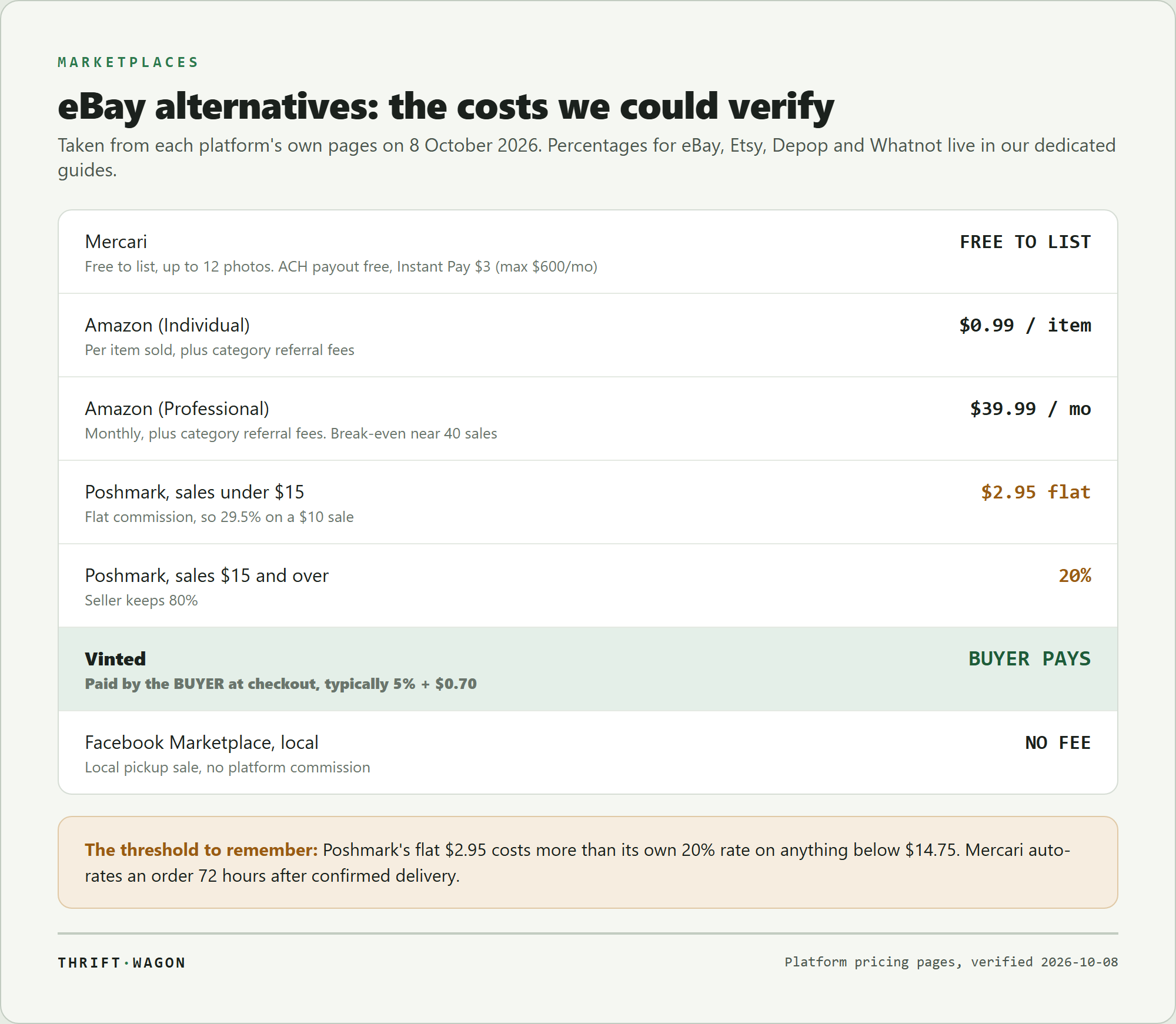
- Amazon charges either $0.99 per item sold on the Individual plan or $39.99 a month on the Professional plan, plus category referral fees.
- Vinted puts the platform fee on the buyer, typically 5% plus $0.70, which is why its sellers keep more of the sale price.
- Poshmark charges a flat $2.95 commission under $15 and 20% at $15 and above, so cheap items carry the heaviest effective rate.
- For most sellers the right move is adding a second platform rather than leaving eBay, because listings are the asset and audiences barely overlap.
Why sellers look for an eBay alternative
Three reasons come up repeatedly, and they point to different replacements.
Fees. eBay’s final value fee is a percentage of the total order plus a per-order charge, which is competitive for general goods but expensive on low-value items. Sellers chasing a lower rate end up looking at Vinted, where the platform fee sits on the buyer, or at local selling where there is no commission at all. Our breakdown of eBay’s selling fees sets the baseline you are comparing against.
Audience mismatch. A $25 pair of trending leggings is competing with thousands of identical listings on eBay and almost nothing on a fashion-first app with a browsing audience. Category fit moves items faster than any fee saving.
Friction and risk. Auctions are binding, buyer protection favours buyers on every major platform, and bad orders cost time. Some sellers simply want fewer shipped parcels, which is an argument for local selling rather than another shipping marketplace.
Be clear about which of the three is actually your problem, because the answer changes the shortlist. A fee complaint solved by moving to a platform with no buyers is not solved.
Mercari: the closest general alternative
Mercari is the most direct substitute for eBay’s everyday business: a broad marketplace where individuals sell almost anything shippable, with the platform handling labels and payments.
What we verified. Mercari states that "listing on Mercari is fast, easy, and free" and that you can add up to 12 photos per listing. On payouts, ACH direct deposit withdrawals are free with a $2 fee applying only to failed withdrawal transactions, limited to one per day and typically received within 5 business days. Instant Pay costs a $3 flat fee per withdrawal, can be used once per day, and allows up to $600 per month on eligible Visa or Mastercard debit cards.
The detail most sellers miss. Mercari "automatically rates a transaction within 72 hours of carrier-confirmed delivery," and an order is complete once the buyer or Mercari rates it. Buyers must open a return request before that happens. That 72 hour clock is the practical difference from eBay’s longer dispute windows: it gets sellers paid faster and gives buyers much less time to change their minds.
Best for: general clutter, electronics, collectables, and anything where eBay’s audience works but its fees on cheap items do not. Worth reading our guide on whether Mercari is legit for the current fee structure and buyer-side charges.

Amazon: the biggest audience, the least control
Amazon is the obvious answer to "where are the buyers" and the wrong answer for most eBay resellers, because the model is fundamentally different.
What we verified. Amazon offers two selling plans: Individual at $0.99 per item sold, and Professional at $39.99 per month. Referral fees vary by category and apply on top of either plan. The Individual plan lists one product at a time and sets static prices; the Professional plan adds bulk operations and the rest of the seller tooling.
The structural difference. On eBay you create a listing for your item. On Amazon you usually attach your offer to a shared catalogue page, competing on price and fulfilment for the same slot. That is efficient for new, identical, in-demand products and hostile to one-off used goods, which is exactly what most resellers have.
The maths on the plans. $39.99 a month is break-even at about 40 items sold, since the Individual plan costs $0.99 per sale. Below that, Individual wins.
Best for: new or replenishable products with real demand. Our head-to-head on eBay versus Amazon covers the listing model, the Buy Box, and who each platform actually suits.
Poshmark: fashion with a social engine
Poshmark is a fashion marketplace where visibility is earned through activity: sharing listings, following, and offers to likers.
What we verified. Poshmark’s commission is a flat $2.95 on sales under $15, and 20% on sales of $15 or more, with the seller keeping 80%. Poshmark also notes that since 1 October 2025, sellers located in Texas see an additional Texas Seller Fee Tax deducted from their earnings.
What the fee structure implies. The crossover point is $14.75. Below that price, the flat $2.95 takes a larger share than the 20% rate does above it, which makes Poshmark a poor home for genuinely cheap single items and a reasonable one for $25 and up. Bundles exist partly to solve this.
The honest trade-off. Poshmark’s 20% is high against eBay, and the sharing requirement is real work. What you get is a browsing audience that arrives wanting clothes, which converts far better than a search-driven audience for mid-market fashion.
Best for: women’s clothing, shoes, and accessories in the $20 to $80 band. Our own analysis of what sells best on Poshmark found a median sold price under $30 for most brands we sampled, which is the number to plan around.

Depop: a younger fashion audience
Depop sits where streetwear, Y2K, and vintage fashion meet an audience that skews considerably younger than eBay’s.
What we verified. Depop’s buyer protection programme, Depop Protection, gives buyers a full refund if an item does not arrive, arrives damaged, or is significantly not as described, provided they paid via Depop Payments and report within 30 days of the date of purchase. The refund covers the full purchase price including shipping, fees and applicable taxes. Cover is void if payment happened outside Depop, including PayPal, Venmo, or bank transfer.
Why that matters to a seller. The protected failures are objective ones. Depop explicitly excludes fit, smells, minor wear on secondhand items, and fabric looking different from the photos. An accurate listing with measurements is therefore a genuine defence, which is not true everywhere.
The trade-off. Lower price points than eBay for most categories, a styling-led presentation that takes effort, and buyers who expect a certain aesthetic in your shop.
Best for: vintage, streetwear, band tees, and anything with a strong visual identity. See our guides on whether Depop is legit and the Depop return policy for the full seller picture.
Vinted: the platform fee moves to the buyer
Vinted is the most structurally different option on this list, because of who pays.
What we verified. Vinted describes the Vinted fee as "a mandatory platform fee paid at checkout when you place an order through Vinted," calculated as "a percentage of the item’s or bundle’s price, as well as a fixed fee, usually 5% + $0.70." The fee is shown in the price breakdown on each listing and added to the order total at checkout, and it includes VAT.
What that means for sellers. The commission a seller would pay elsewhere is charged to the buyer instead. There is no sharing grind, no commission deducted from your payout on the item price, and no need to price in a 20% cut.
The catch. Buyers see a higher total than the sticker price, which pushes the whole market toward lower prices. Vinted’s audience is budget and everyday clothing rather than premium pieces, so the fee saving arrives alongside lower average sale prices.
Best for: high-volume, lower-value everyday clothing, especially if you dislike the engagement mechanics of Poshmark. Our comparison of Vinted and Poshmark covers the audience difference in detail.
Whatnot: selling live instead of listing
Whatnot replaces the listing with a livestream. You run a show, hold items up, and sell them by auction while people watch.
That changes what sells well. The categories that thrive are ones where the unboxing or the reveal is the entertainment: trading cards, sneakers, comics, collectables, toys, and sports memorabilia. Anything whose appeal is an exact spec sheet does worse live than in a search result.
It also changes the work. Instead of photographing and writing fifty listings, you spend two hours on camera. That suits some sellers enormously and others not at all, and there is no middle ground to test your way into: a stream with three viewers does not sell much.
The genuine advantage is sell-through speed on inventory that is hard to price. A live auction finds the market price for an ungraded card in ninety seconds, which no amount of comping does as accurately.
Best for: collectables with an audience, bulk lots you want gone in one session, and sellers comfortable on camera. Start with our guide on how to sell on Whatnot for the format and the commission structure.

Facebook Marketplace: local, physical, no shipping
Facebook Marketplace is the alternative for everything eBay makes painful: furniture, appliances, exercise equipment, bulky bargains, and anything whose shipping cost exceeds its value.
The model is local pickup, cash or an in-app payment, and a buyer who comes to you. No packaging, no labels, no lost parcels, and no returns process to lose.
The honest trade-offs, and they are significant:
- No meaningful buyer or seller protection on a local cash sale. You are two strangers meeting, which is why public meeting spots and daylight are the standard advice.
- No-shows are routine. Interest costs a buyer nothing, so expect several conversations per sale.
- Lowballing is the culture, not an insult.
- Prices are local, so a thin local market caps what you can get regardless of national demand.
Best for: large, heavy, low-value-per-pound items, and quick clear-outs. It is a poor fit for small high-value goods, where eBay’s protections and national audience are worth the fees. We have not verified Facebook’s current shipped-order selling fee from Meta’s own documentation, so treat local pickup as the use case here.

Etsy: handmade, vintage, and craft supplies
Etsy overlaps with eBay in exactly one place, and it is a place many resellers underuse: genuine vintage.
Etsy’s categories are handmade items, vintage goods aged 20 years or older, and craft supplies. If your sourcing turns up 1970s glassware, mid-century linens, vintage sewing patterns, or old jewellery, Etsy’s buyers arrive already wanting those things and paying accordingly.
What Etsy will not take is the bulk of a typical reseller’s inventory. Used modern clothing, current electronics, and recent-era branded goods do not qualify, so Etsy is an addition for a slice of your stock rather than a replacement for eBay.
The trade-off is a shop you have to merchandise. Etsy rewards consistent photography, listing SEO, and a coherent shop identity far more than eBay does, and a single vintage item dropped into an empty shop will sit.
Best for: true vintage, handmade work, and digital products. Our guides on Etsy versus eBay and whether selling on Etsy is worth it cover the fee structure and the seller experience.

Which alternative matches what you sell
The decision is category first, fee structure second.
| What you sell | Best alternative | Why |
|---|---|---|
| General used goods, electronics, collectables | Mercari | Closest model to eBay, free to list, fast 72 hour completion |
| New, replenishable products | Amazon | Largest audience, but shared catalogue and either $0.99 per item or $39.99 a month |
| Women’s fashion $20 to $80 | Poshmark | Browsing audience, though 20% commission above $15 |
| Vintage, streetwear, Y2K | Depop | Younger audience, visual shops, 30 day buyer protection window |
| Everyday clothing in volume | Vinted | Platform fee charged to the buyer, typically 5% plus $0.70 |
| Cards, sneakers, collectables | Whatnot | Live auctions find prices fast |
| Furniture, appliances, bulky items | Facebook Marketplace | Local pickup, no shipping, no commission on local cash sales |
| Genuine vintage (20+ years), handmade | Etsy | Buyers arrive looking for exactly that |
Notice that nothing in this table says "everything." That is the real finding: eBay’s breadth is its advantage, and every alternative beats it inside a narrower lane.
For the full cost comparison across platforms, see what each marketplace charges sellers.
Should you leave eBay, or add a second platform?
For most sellers, add. Leaving is rarely the rational move, for three reasons.
Your listings are an asset. An established eBay account with feedback, search history, and live listings produces sales passively. Deleting that to save a few points of commission trades an income stream for a hypothesis.
Audiences barely overlap. The person who searches eBay for a specific part number is not browsing Depop. Listing the same inventory in two places roughly doubles its exposure, which is why cross-listing exists as a category of software.
Fee differences are smaller than fit differences. Moving an item from a platform charging 13% to one charging 10% saves 3%. Moving it to a platform where it sells in a week instead of six months changes the business.
The practical sequence:
- Keep eBay running.
- Pick one second platform matching your strongest category.
- List 20 to 30 items there and give it a month.
- Compare sell-through, not just fees.
- Expand only if the second platform earns its admin time.
Two platforms run well beats five run badly, because every extra platform multiplies messages, shipping deadlines, and the risk of selling the same item twice.
What to check before you move inventory
Five checks that prevent most expensive surprises.
1. Does the platform allow your category? Etsy requires handmade, vintage over 20 years old, or craft supplies. Poshmark and Depop are fashion-led. Check before you photograph a hundred items.
2. Who pays the platform fee? On Vinted it is the buyer, typically 5% plus $0.70. On Poshmark it is the seller, $2.95 flat under $15 and 20% above. That single difference changes how you price.
3. How fast does the money arrive, and at what cost? Mercari’s ACH payouts are free, typically 5 business days, with Instant Pay at $3 per withdrawal up to $600 a month. Cash flow matters if you are reinvesting in stock.
4. What is the buyer protection window? Depop gives buyers 30 days from purchase to report a problem. Mercari auto-rates a transaction within 72 hours of confirmed delivery. Those are very different exposure profiles for a seller.
5. What happens when an order goes wrong? Read the returns policy before you need it, not after. Our guides to the Depop return policy and the Poshmark return policy are the two most commonly misunderstood.
Verify fees on the platform’s own page before committing, because every number in this guide has a date on it for a reason.
Frequently asked questions
What is the best alternative to eBay for sellers?
Mercari for general used goods, because the model is closest to eBay’s: broad categories, free listings, built-in shipping. For fashion, Poshmark, Depop, or Vinted depending on price point and audience age. For bulky local items, Facebook Marketplace. There is no single replacement for eBay’s breadth.
Which selling site has the lowest fees?
Vinted charges the platform fee to the buyer, typically 5% plus $0.70, so sellers keep more of the sale price. Local sales on Facebook Marketplace carry no commission at all. The trade-off is lower average sale prices on Vinted and no buyer protection on a local cash sale.
How much does it cost to sell on Amazon instead of eBay?
Amazon offers an Individual plan at $0.99 per item sold or a Professional plan at $39.99 per month, with category referral fees on top of either. The Professional plan breaks even at roughly 40 sales a month. The bigger difference is structural: Amazon usually attaches your offer to a shared catalogue page.
Can I sell the same item on eBay and another site at once?
Yes, and most established resellers do. The risk is selling the same physical item twice, so you need a routine for pulling a listing the moment it sells elsewhere. Cross-listing tools exist for this. Start with two platforms rather than five, since each one adds messages and shipping deadlines.
Is Poshmark cheaper than eBay?
Usually not. Poshmark charges 20% on sales of $15 or more, which is above eBay’s typical rate, and a flat $2.95 below $15 which works out at more than 20% on anything under $14.75. What Poshmark offers instead is a fashion-focused browsing audience that converts better for mid-market clothing.
Where should I sell furniture instead of eBay?
Facebook Marketplace, locally. Shipping furniture usually costs more than the item is worth, and local pickup removes packaging, labels, and lost-parcel risk entirely. Expect no-shows and lowball offers, meet in daylight, and remember that a local cash sale carries no platform buyer or seller protection.
What sellers are reporting
Resellers consistently advise adding one platform at a time rather than migrating, and report that sell-through differences between platforms matter far more to income than the gap in commission rates.
members of the r/Flipping community, community post
Sellers who cross-list repeatedly warn about double-selling the same physical item and describe pulling listings immediately after a sale as the discipline that makes multi-platform selling workable.
members of the r/Mercari community, community post
What this guide does not cover
This guide compares platforms by fit and by the costs we could verify from each platform’s own pages on 8 October 2026. It does not restate every platform’s full fee schedule: eBay, Etsy, Depop, Mercari and Whatnot percentages are covered in our dedicated guides to each. We could not verify Facebook Marketplace’s current shipped-order selling fee from Meta’s own documentation, so no figure is quoted for it. Fees and policies change, so check the platform’s own page before you commit.
Sources
- Amazon offers an Individual selling plan at $0.99 per item sold and a Professional plan at $39.99 per month, with referral fees varying by category. (Amazon)
- Poshmark takes a flat $2.95 commission on sales under $15 and 20% on sales of $15 or more, and since 1 October 2025 sellers located in Texas see an additional Texas Seller Fee Tax deducted. (Poshmark Support)
- The Vinted fee is a mandatory platform fee paid by the buyer at checkout, typically 5% plus $0.70, shown in the listing price breakdown and added to the order total. (Vinted)
- Listing on Mercari is free and sellers can add up to 12 photos to a listing. (Mercari Help Center)
- Mercari ACH direct deposit withdrawals are free with a $2 fee only for failed transactions, limited to one per day and typically received within 5 business days, while Instant Pay costs $3 per withdrawal, once per day, up to $600 per month on eligible debit cards. (Mercari Help Center)
- Mercari automatically rates a transaction within 72 hours of carrier-confirmed delivery, and buyers must initiate a return request before the transaction is completed. (Mercari Help Center)
- Depop Protection refunds the full purchase price if an item does not arrive, arrives damaged, or is significantly not as described, when paid via Depop Payments and reported within 30 days of purchase, and does not apply to payments made outside Depop. (Depop Help Centre)
- Depop excludes fit, smells, minor damage on secondhand or vintage items, and material looking different from the images from not as described claims. (Depop Help Centre)