How Does Depop Work? Buying, Selling & Fees (2026)
Verified 2026-08-01
Depop is a social marketplace for buying and selling mostly secondhand fashion, built around a visual feed like Instagram. Buyers browse or search, buy or make an offer, and pay in the app; sellers photograph and list items, arrange shipping, and get paid once the buyer receives the item. This guide explains exactly how Depop works for both buyers and sellers, including offers, bundles, shipping, fees, and the buyer protection that keeps purchases safe.
Key takeaways
- Depop is a visual, social fashion marketplace: discovery happens through a feed, search, and hashtags rather than category browsing alone.
- Buyers pay in the app, and Depop holds the payment under Depop Protection until the buyer receives the item.
- Depop dropped its selling commission for US sellers, so sellers pay only payment processing, about 3.3% plus $0.45 per sale.
- Offers let buyers and sellers negotiate, and bundles let buyers combine items from one shop for a combined price and shipping.
- Sellers arrange their own shipping, unlike marketplaces with a single flat label.
What is Depop?
Depop is a social marketplace for fashion, mostly secondhand, aimed at a young, trend-driven audience. It launched in 2011, is owned by Etsy, and is one of the most popular resale apps for streetwear, vintage, Y2K, and unique pieces. What sets it apart is the format: it works like a visual feed, closer to Instagram than a classic marketplace.
Instead of browsing dry category lists, you scroll an explore feed, follow shops you like, and discover items through photos, hashtags, and search. Every seller has a personal shop that reads like a curated profile, and the look and feel of that shop drives what gets seen.
For buyers, that means a browsable, style-led catalog of fashion with buyer protection built in. For sellers, it means presentation is everything: a well-shot, well-tagged listing gets discovered, and a dull one disappears. The sections below break down each side, plus the fees and protection that tie it together.
How buying on Depop works
Buying is simple:
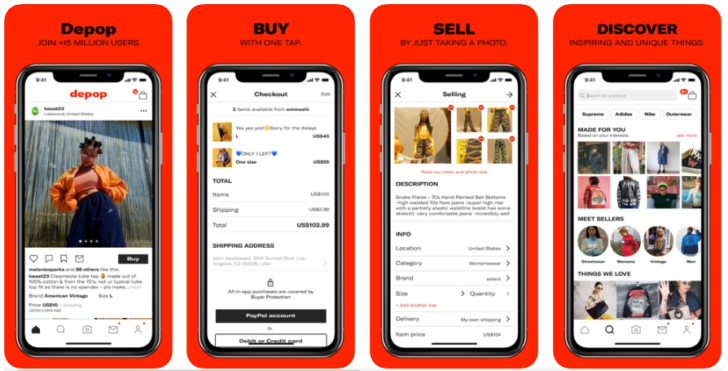
- Find an item by scrolling the feed, searching, or browsing a shop or hashtag.
- Buy it now, or make an offer. Depop is negotiation-friendly, so many buyers send an offer below the list price.
- Pay in the app. Depop holds your payment rather than sending it straight to the seller.
- The seller ships the item, usually with tracking.
- Receive the item. Once it arrives as described, the transaction completes and the seller is paid.
That payment hold is the core of buyer protection: your money stays with Depop until the sale is complete, so if the item never arrives or is not as described, you have recourse. Buyers pay the item price plus shipping, plus a small marketplace fee added at checkout. Communication and payment both stay in the app, which is what keeps the purchase protected.
How selling on Depop works
Selling mirrors the buying flow, with presentation doing the heavy lifting:
- List an item with photos, a description, brand, size, condition, price, and hashtags.
- Get discovered through the feed, search, and hashtags. A strong, consistent shop aesthetic pulls in followers, who see your new listings first.
- A buyer purchases or makes an offer, which you accept, counter, or decline.
- Ship it yourself, either buying a label through Depop or using your own postage, with tracking.
- Get paid after the buyer receives the item, minus payment processing.
The key difference from a flat-label marketplace is that you arrange shipping and that photography drives sales. A beautifully shot, well-tagged listing converts; a dark, cluttered one does not, no matter how good the item. For a full walkthrough, see our guide to selling on Depop.

Offers and bundles explained
Two features drive a lot of Depop sales, and both are worth understanding:
Offers. Depop is built for negotiation. A buyer can send a private offer below the list price, and the seller can accept, counter, or decline. Sellers can also send offers to people who have liked an item, which reaches buyers who already want the piece and is one of the most effective ways a sale actually closes.
Bundles. A buyer can add several items from the same shop into a bundle and buy them together, often for a combined price and combined shipping. Sellers frequently advertise a bundle discount in their bio to encourage larger orders, which raises the order value and saves the buyer on shipping.
Together, offers and bundles make Depop feel more like a negotiated marketplace than a fixed-price store, and using them well is central to both buying deals and selling faster.
Shipping on Depop
Unlike marketplaces with a single flat label, Depop puts shipping in the seller’s hands, which is worth knowing on both sides.
- Sellers arrange shipping. You can buy a shipping label through Depop’s integrated shipping for tracked postage, or use your own carrier. You decide whether the buyer pays for shipping or you offer free shipping with the cost built into the price.
- Tracking matters. A tracked label protects the seller against false ‘item not received’ claims and reassures the buyer.
- Buyers see the shipping cost at checkout, and can save on it by bundling multiple items from one shop.
The practical upshot is that Depop shipping is more flexible than a flat-rate system, and often cheaper on small, light fashion items, but it does require the seller to weigh, price, and buy the label. Getting it right protects the seller’s low-fee advantage.

Depop’s fees and Depop Protection
Fees. Depop changed its fee model recently, so ignore older guides. For US sellers in 2026 there is no selling commission and no listing fee; sellers pay only payment processing, roughly 3.3% plus $0.45 per transaction. Buyers pay a separate marketplace fee at checkout. So on a $50 item, a seller pays only about $2.10 in processing and keeps roughly $47.90 before shipping, which makes Depop one of the cheapest platforms for sellers.
Depop Protection. This is Depop’s buyer protection. Because Depop holds the buyer’s payment until the item is received, a buyer whose item never arrives or is not as described can report it and is protected. It does not cover buyer’s remorse or anything arranged off the platform.
Together, low fees and Depop Protection are what make Depop approachable to sell on and safe to buy on. For how Depop compares with other apps, see our marketplace fee comparison, and for the full safety picture, whether Depop is legit.
What sells on Depop, and who is buying
Depop’s audience shapes what works. Buyers skew Gen-Z and young millennial, fashion-forward, and trend-driven, so the strongest categories are:
- Streetwear and hyped brands.
- Vintage and Y2K pieces.
- Thrifted and upcycled clothing with a distinct look.
- Indie and niche labels, and anything with a strong aesthetic.
Buyers often shop for a vibe as much as a specific item, browsing shops the way they browse a social feed. That is why a cohesive, well-photographed shop outperforms a large pile of generic listings.
Mainstream, mass-market basics and older-skewing fashion tend to move slowly here and usually do better on a broader marketplace. If your inventory is distinctive and photogenic, and you enjoy styling and shooting it, Depop is a strong fit. If it is generic, another platform may reach more of the right buyers.

Is Depop worth using?
For buying and selling trend-led fashion, Depop is worth using if it fits how you like to shop or sell. Buyers get a browsable, style-led catalog of streetwear, vintage, and unique pieces with buyer protection and room to negotiate through offers and bundles. Sellers get very low fees and a young, engaged audience, in exchange for doing their own shipping and investing real effort in photography.
Where Depop excels is distinctive, photogenic fashion and a social, visual experience. Where it is weaker is mainstream basics and passive, list-and-forget selling.
Many people also weigh it against alternatives depending on their catalog. If you sell brand-name mainstream fashion, it is worth seeing how Depop compares with Poshmark before you choose. For trend-led pieces and the lowest fees, Depop is hard to beat.
Frequently asked questions
How does Depop work for beginners?
You create a free account, then buy by scrolling the feed or searching and paying in the app, or sell by listing items from your shop with photos and hashtags. Depop holds buyer payments until the item is received, sellers arrange their own shipping, and Depop charges sellers only payment processing when an item sells.
How does buying on Depop work?
Find an item by browsing or searching, then buy it or send an offer below the list price. You pay in the app, and Depop holds the payment. The seller ships with tracking, and once the item arrives as described the sale completes. Buyers pay the item price, shipping, and a small marketplace fee.
Does Depop charge fees?
For US sellers, Depop dropped its selling commission, so sellers pay only payment processing of about 3.3% plus $0.45 per sale, with no listing fee. Buyers pay a separate marketplace fee at checkout. That makes Depop one of the cheapest platforms for sellers, with the main cost being shipping, which sellers arrange.
What is a bundle on Depop?
A bundle lets a buyer combine several items from the same shop into one order, often for a combined price and combined shipping. Sellers can offer a bundle discount to encourage it, which raises the order value and saves the buyer on shipping. Many sellers advertise bundle deals in their bio.
What sells best on Depop?
Streetwear, vintage, Y2K, thrifted and upcycled pieces, indie brands, and anything with a distinct, on-trend aesthetic, sold to a young audience. Unique and photogenic beats generic. Mainstream mass-market basics move slowly, so lead with distinctive pieces and shoot them well.
Is Depop safe to buy on?
Yes, when you keep the transaction in the app. Depop holds your payment under Depop Protection until you receive the item, and covers items that never arrive or are not as described. It does not cover buyer’s remorse or deals arranged off the platform, so keep payment and messaging on Depop.
What sellers are reporting
Depop users on community forums explain that discovery runs on strong photography and accurate hashtags, and that offers to likers and bundle deals are how most sales actually close.
members of the r/Depop community, community post
Buyers describe Depop Protection resolving not-as-described and non-delivery cases, while complaints cluster around deals moved off the app.
reviewers on Trustpilot, review
What this guide does not cover
This explains how Depop works for US users in 2026; fees, shipping options, and features change and can differ by country, so confirm current details on Depop. It is general guidance, not financial advice.
Sources
- Depop removed its selling commission for US sellers, leaving only payment processing fees; buyers pay a marketplace fee. (Depop Newsroom)
- Marketplace fee comparison across eBay, Poshmark, Etsy, Mercari, and Depop. (Thrift Wagon)