Is Depop Legit? The Complete 2026 Safety Guide
Verified 2026-07-22
Yes, Depop is legit. It is an established secondhand-fashion marketplace, owned by Etsy since 2021, with millions of buyers and sellers, in-app payments, and its own buyer-protection program. That does not make it scam-free, because any peer-to-peer marketplace attracts bad actors, but the risks are well understood and mostly avoidable. This complete guide explains how Depop works, exactly what Depop Protection covers, every common scam and how to spot it, the step-by-step process for getting a refund if something goes wrong, how to sell safely, and how Depop compares with other resale apps.

Key takeaways
- Depop is a legitimate marketplace, owned by Etsy since 2021, not a scam site.
- Depop Protection covers purchases that don’t arrive, arrive damaged, are inauthentic, or aren’t as described, with a full refund within a 30-day window.
- The catch: protection only applies to payments made inside the Depop app, which is why scammers push buyers to pay off-platform.
- If something goes wrong, message the seller first, then open a case in Purchases or the Resolution Centre with photo evidence; Depop aims to resolve within about 10 business days.
- Sellers are protected too if they ship with tracking, describe items honestly, and keep everything in the app.
- The common risk, paying off-platform, exists on every resale app, so the same safety habits apply to Poshmark, Vinted, and Mercari.
Is Depop legit? The short answer
Yes. Depop is a real, established marketplace for secondhand and vintage fashion, and it has been owned by Etsy since 2021. It has millions of active users worldwide, processes payments through the app, and runs its own buyer-protection program. It is not a fly-by-night operation or a scam site; it is one of the major players in online resale, especially for Gen-Z fashion, streetwear, and vintage.
The honest caveat is that Depop, like every platform where individuals sell to individuals, has scammers operating on it. That is equally true of eBay, Poshmark, Mercari, and Vinted. Two different questions get blurred together here: is the platform legitimate, and is this particular seller trustworthy. The platform is legitimate. Whether a given seller is depends on signals you can check, and the rest of this guide is about reading those signals and using the protections Depop provides.
How Depop works, briefly
If you are new to Depop, a quick orientation helps the safety advice make sense. Depop is an app-based marketplace: sellers photograph and list items, buyers browse and purchase, and payment goes through the app using a card or a linked payment method. The seller ships the item, the buyer receives it, and both can leave reviews that build a public reputation over time.
The important structural point is that the money and the messages live inside Depop. That is what makes the platform’s protection possible: because Depop processes the payment and can see the transaction history, it can step in when something goes wrong. Everything that follows, the protection, the disputes, the refunds, depends on the sale happening inside that system. The moment a transaction moves outside it, Depop can no longer see it or help with it, which is the single fact that explains almost every scam on the platform.

Depop Protection: exactly what is covered
Depop Protection is the program that makes buying safe when you follow the rules. It covers a purchase that:
- never arrives (lost in transit or never shipped),
- arrives damaged,
- turns out to be inauthentic, meaning a counterfeit sold as genuine, or
- is not as described, including the wrong item, wrong color, or undisclosed major flaws and wear.
When one of those applies, you can get a full refund within a 30-day window by opening a case through the app. This is the backbone of buying on Depop with confidence: if the item is wrong, fake, or missing, you are covered. It is what separates a protected marketplace purchase from a risky private sale between strangers, and it is the reason the next section is the most important one in this guide.
The one rule that keeps you safe: stay in the app
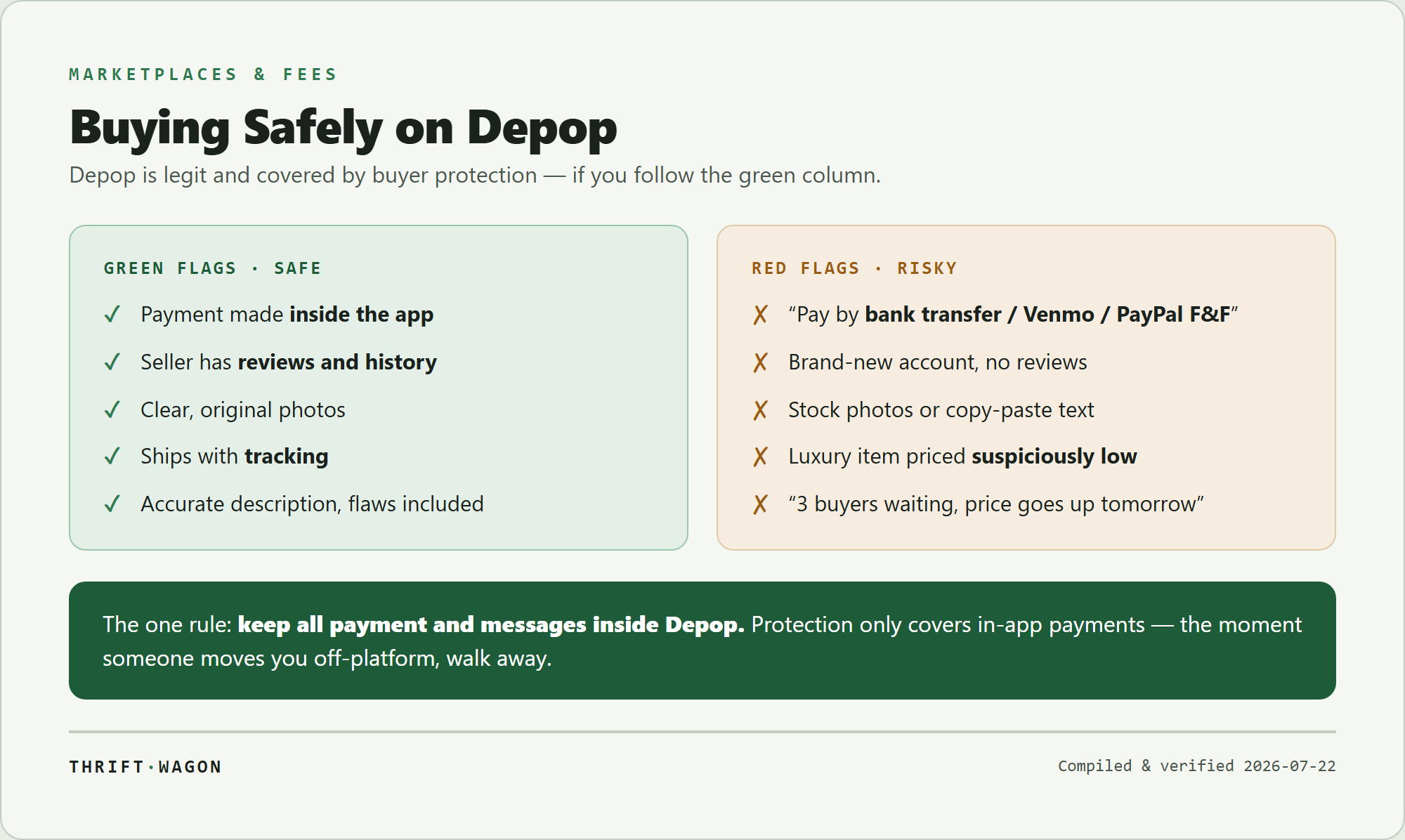
Here is the catch that every scam exploits: Depop Protection only applies to payments made inside the Depop app. Payments made off-platform, by direct bank transfer, PayPal Friends & Family, Venmo, or Cash App, are not covered.
That is why the single most common move in a Depop scam is a seller asking you to pay outside the app to "save on fees" or "do it faster." Once your money leaves Depop, there is no case to open, no refund to request, and no record for Depop to act on. The scammer keeps the money and you have no recourse.
The rule that defeats almost every scam is therefore simple and non-negotiable: keep all communication and payment strictly inside Depop. A genuine seller has no reason to move you off-platform. The moment someone tries, whatever the justification, that is your signal to stop and walk away. On-platform, you are protected; off-platform, you are on your own.
The common Depop scams, in detail
Most Depop scams fall into a handful of recognisable patterns. Knowing each one by name makes it much harder to fall for.
Off-app payment requests. A seller or buyer pushes you to pay or be paid outside Depop, usually framed as a discount, a favor, or a faster transaction. This is the master scam, because it removes protection for everything below.
Fake designer goods. Counterfeits sold as genuine, common with luxury and hype brands. Depop Protection covers these as inauthentic if you paid in-app, which is another reason to never go off-platform for a "deal" on a designer piece.
Ghost sellers. An account takes your in-app payment and simply never ships, then goes quiet or disappears. Protection covers non-delivery, so this is recoverable, but it is a hassle you can avoid by checking seller history first.
Phishing. Messages or links, often posing as Depop itself, that try to capture your login or payment details. Depop will never ask for your password in a message, and you should never log in through a link someone sends you.
Fake buyer return claims. On the selling side, a buyer falsely claims an item was "not as described" to get a refund while keeping the item, or swaps in a different item to return. This is why sellers need documentation, covered below.
Triangulation and overpayment. Less common but worth knowing: schemes where a scammer uses a stolen card to buy your item and ship it elsewhere, or "accidentally overpays" and asks for the difference back off-platform. Anything involving money moving outside the normal in-app flow is suspect.
Notice the thread running through all of them: they either move money off-platform or exploit a lack of documentation. Both are defendable with the habits in the next two sections.

How to spot a risky seller before you buy
Check the seller before you check out. The reassuring signals are a consistent track record: a history of positive reviews, clear original photos of the actual item, an account that has been active for a while, and prompt, coherent communication.
The red flags to avoid:
- A brand-new account with no sales history and no reviews.
- Vague or copy-paste descriptions that don’t match the photos, or stock images instead of real ones.
- Suspiciously low prices, especially on high-demand or luxury items, which is the classic bait for counterfeits and ghost sellers.
- Pressure tactics like "three other buyers are waiting" or "the price goes up tomorrow," engineered to compress your verification time.
- Any push to communicate or pay off Depop, which as covered is the biggest single warning sign.
None of these guarantees a scam on its own. A new account can be a genuine first-time seller. But two or more together, or any off-platform request, is a clear reason to slow down or pass. When a deal on a valuable item looks too good, it usually is.
What to do if something goes wrong: getting a refund
If a purchase arrives damaged, fake, wrong, or never shows up, Depop Protection gives you a path to a refund. The process, in order:
- Message the seller first. Use Depop’s in-app messaging to explain the problem politely, attach photos, and ask them to resolve it. Give them a reasonable window, around 48 hours, to respond. Many issues are settled here without a formal case.
- Open a dispute in the app. If the seller is unresponsive or unwilling, go to your Purchases under "my Depop," select the item, and start a dispute. You can also use the Resolution Centre via Menu, then Support, to manage your cases.
- Upload your evidence. Add photos showing the damage or discrepancy and screenshots of your conversation with the seller. Good evidence is what wins a case.
- Let Depop’s team review it. Depop’s resolution team steps in and generally aims to resolve disputes within about 10 business days, though complex cases can take longer.
- Receive your refund. Once a refund is agreed, it typically takes 3 to 5 business days to reach your card, PayPal, or bank, depending on your payment method.
One extra path: if you paid through PayPal, you can also raise a dispute with PayPal directly, and a not-as-described claim can generally be opened with either Depop or PayPal within 30 days of purchase. The consistent theme is that acting inside the app, promptly, with evidence, is what gets your money back.
Selling on Depop safely
Sellers face the mirror-image risk, mainly the fake-return claim, and the defence is documentation.
Always ship with tracking. Proof of delivery defeats a false "it never arrived" claim outright, and it is the single most important habit for sellers.
Photograph the item and packaging before it ships, especially for higher-value pieces, so you can prove its condition if a buyer claims damage or a swap.
Describe items honestly, including every flaw. An accurate listing, with photos of any wear, is your best evidence against a "not as described" claim, and it also reduces genuine disputes.
Keep the transaction and all messages inside Depop, so the platform can see the full history if a case is opened, and never agree to be paid off-app, which removes your protection exactly as it removes the buyer’s.
Depop’s protections work both ways when you use the system as intended. A seller who ships tracked, documents condition, and describes honestly is in a strong position in any dispute, because the evidence is on their side.

Keeping your account secure
Beyond individual transactions, protect the account itself. Depop will never ask for your password in a message, so treat any message that does, or any link asking you to "verify" or "log in," as phishing. Never log in through a link someone sends you; open the app directly instead.
Use a strong, unique password for Depop that you do not reuse elsewhere, and enable any available account-security options. Be wary of messages that create urgency around your account, such as claims that it will be suspended unless you act immediately, which is a classic phishing pattern. A compromised account can be used to scam your followers in your name, so account security protects your reputation as well as your money.
Is Depop safer than other resale apps?
Depop’s safety is broadly comparable to the other major peer-to-peer resale apps. Poshmark, Vinted, and Mercari all run their own buyer-protection or authenticity programs, all process payments in-app, and all share the same core vulnerability: protection evaporates the moment a transaction moves off-platform.
So the honest answer is that Depop is neither uniquely safe nor uniquely risky. The determining factor is not which app you use but whether you follow the on-platform rules on any of them. A careful buyer keeping payments in-app and checking seller history is well protected across all of them; a buyer who agrees to pay by bank transfer is exposed on every one. If you want to weigh the platforms on cost rather than safety, the differences show up mostly in fees, which we cover separately.

So, should you use Depop?
Depop is a legitimate, well-established marketplace, and for buying and selling secondhand fashion it works well when you use it as intended. The platform is not the risk; specific bad actors are, and the protection program plus a few habits neutralise the large majority of them.
Use it with three rules and you will rarely have a problem: keep everything in the app, check the other party’s history, and document what you send or receive. If a deal only works by going off-platform, it is not a deal, it is the setup for the most common scam on the site. Follow those, know how to open a dispute if you need to, and Depop is as safe as any major resale marketplace, and a genuinely good place to find and sell secondhand fashion.
Frequently asked questions
Is Depop legit and safe to use?
Yes. Depop is an established secondhand-fashion marketplace owned by Etsy since 2021, with its own buyer-protection program. Like any peer-to-peer platform it has some scammers, but purchases paid for inside the app are covered against items that don’t arrive, are damaged, are fake, or aren’t as described.
Can you get scammed on Depop?
You can, but almost every Depop scam relies on moving the payment off the app, where buyer protection does not apply. If you keep all communication and payment inside Depop, check the seller’s reviews and history, and avoid deals that seem too cheap, you defeat the large majority of scams before they start.
What does Depop Protection cover?
Depop Protection covers purchases that never arrive, arrive damaged, turn out to be inauthentic, or are not as described, including the wrong item, wrong color, or undisclosed major flaws. You can request a full refund within a 30-day window through the app. The key condition is that you paid inside Depop; off-platform payments are not covered.
Why do Depop sellers ask you to pay outside the app?
Because it removes buyer protection. Payments made by bank transfer, PayPal Friends & Family, Venmo, or Cash App fall outside Depop Protection, so a scammer who takes your money off-platform faces no refund risk. A request to pay outside the app is the single biggest warning sign on Depop, whatever reason is given.
How do I get a refund on Depop?
Message the seller first with photos and give them about 48 hours. If that fails, open a dispute from your Purchases or the Resolution Centre in the app, and upload photos of the problem plus screenshots of your conversation. Depop’s team reviews it, generally within about 10 business days. If you paid via PayPal, you can also dispute through PayPal.
How long does a Depop refund take?
Depop generally aims to resolve a dispute within about 10 business days, though complex cases can take longer. Once a refund is agreed, it typically takes another 3 to 5 business days to reach your card, PayPal, or bank account, depending on your payment method.
Is Depop safe for sellers?
Yes, if you protect yourself. Ship with tracking so you can prove delivery, photograph the item and packaging before sending, describe items honestly including flaws, and keep everything in the app. Those habits make you strong in any dispute and defend against the main seller-side risk, a false not-as-described return claim.
Is it safe to buy designer items on Depop?
It can be, but designer and hype items are where counterfeits concentrate. Buy from sellers with strong reviews and real photos, be extremely wary of luxury pieces priced far below market, and never pay off-platform. Because Depop Protection covers inauthentic items bought in-app, staying inside the app is what preserves your ability to get a refund if a piece turns out to be fake.
How we checked this
Compiled Depop’s legitimacy, ownership, buyer-protection coverage, dispute and refund process, and the common scam patterns from Depop’s own help documentation and consumer-security and reseller guides, and organised them into a full safety guide Depop Protection coverage, the refund/dispute process, and the recurring scam types and red flags. Collected 2026-07-22.
What this guide does not cover
This guide explains how Depop’s protection, disputes, and common scams work at a general level, and Depop’s exact terms, coverage windows, timelines, and processes can change, so confirm the current details in the app and Depop’s own help pages before relying on them. It is general safety information, not a guarantee against every possible scam, and refund timelines vary by case and payment method. Always read the platform’s current buyer-protection terms.
Sources
- Depop’s refund process: messaging the seller, opening a dispute in Purchases or the Resolution Centre, evidence, timelines, and PayPal path — Depop Help Centre
- Depop is safe and legit, how buyer protection works, and how to buy and sell more safely including avoiding off-platform payment scams — Norton LifeLock
- Depop legitimacy, Etsy ownership since 2021, Depop Protection coverage and 30-day refund window, and common scam patterns — Vendoo


[…] Whether Depop is legit […]