Is Poshmark Legit? The Complete 2026 Safety Guide
Verified 2026-07-22
Yes, Poshmark is legit. It is a publicly traded US resale marketplace, founded in 2011, listed on Nasdaq in 2021, and acquired by Naver in 2023, with millions of buyers and sellers, in-app payments, buyer protection on every order, and free authentication on luxury items. Like any peer-to-peer platform it still has scammers, but the risks are well defined and mostly avoidable. This complete guide covers how Poshmark works, exactly what Posh Protect and Posh Authenticate cover, every common scam and how to spot it, how to open a case and get a refund, how to sell safely, and how Poshmark compares with other resale apps.

Key takeaways
- Poshmark is a legitimate, publicly traded marketplace, founded in 2011 and owned by Naver since 2023.
- Posh Protect covers every purchase: you can open a case within 3 days of delivery for undisclosed damage, a wrong or missing item, or authenticity concerns.
- Posh Authenticate provides free expert authentication on items priced $500 or more before they ship; items under $500 are not authenticated.
- Protection only applies to on-platform payments, so any request to pay off-app is the biggest warning sign.
- Sellers are protected by the 3-day acceptance window, but high-value sellers can still face chargebacks and item-swap claims, so documentation matters.
- Poshmark does not accept returns for buyer’s remorse; cases are for genuine problems, not a change of mind.
Is Poshmark legit? The short answer
Yes. Poshmark is a real, well-established resale marketplace. It launched in 2011, went public on Nasdaq in 2021, and was acquired by Naver in 2023. It has millions of active buyers and sellers, processes payments in-app, and runs both a buyer-protection program and a luxury authentication service. This is not a questionable site; it is one of the largest fashion-resale platforms in the US.
As with every peer-to-peer marketplace, the platform being legitimate is a separate question from whether a given seller is trustworthy. Poshmark is legitimate and comparatively well-protected. Whether a particular listing is safe depends on signals you can check and on using the protections correctly, which is what the rest of this guide covers.
How Poshmark works, briefly
A quick orientation helps the safety advice land. On Poshmark, sellers list items with photos and prices, buyers purchase or make offers, and payment goes through Poshmark. The seller ships using a prepaid label, and once the buyer receives the item they have a short window to accept it or report a problem.
That acceptance window is a defining feature. If the buyer does not report an issue within 3 days of delivery, the order is automatically accepted, the sale completes, and the seller is paid. This one mechanic shapes both sides of safety: it gives buyers a protected window to flag problems, and it gives sellers certainty that a completed sale is final. Everything below, the protection, the disputes, the refunds, runs inside this in-app system, which is exactly why staying on-platform matters so much.
Posh Protect: exactly what is covered
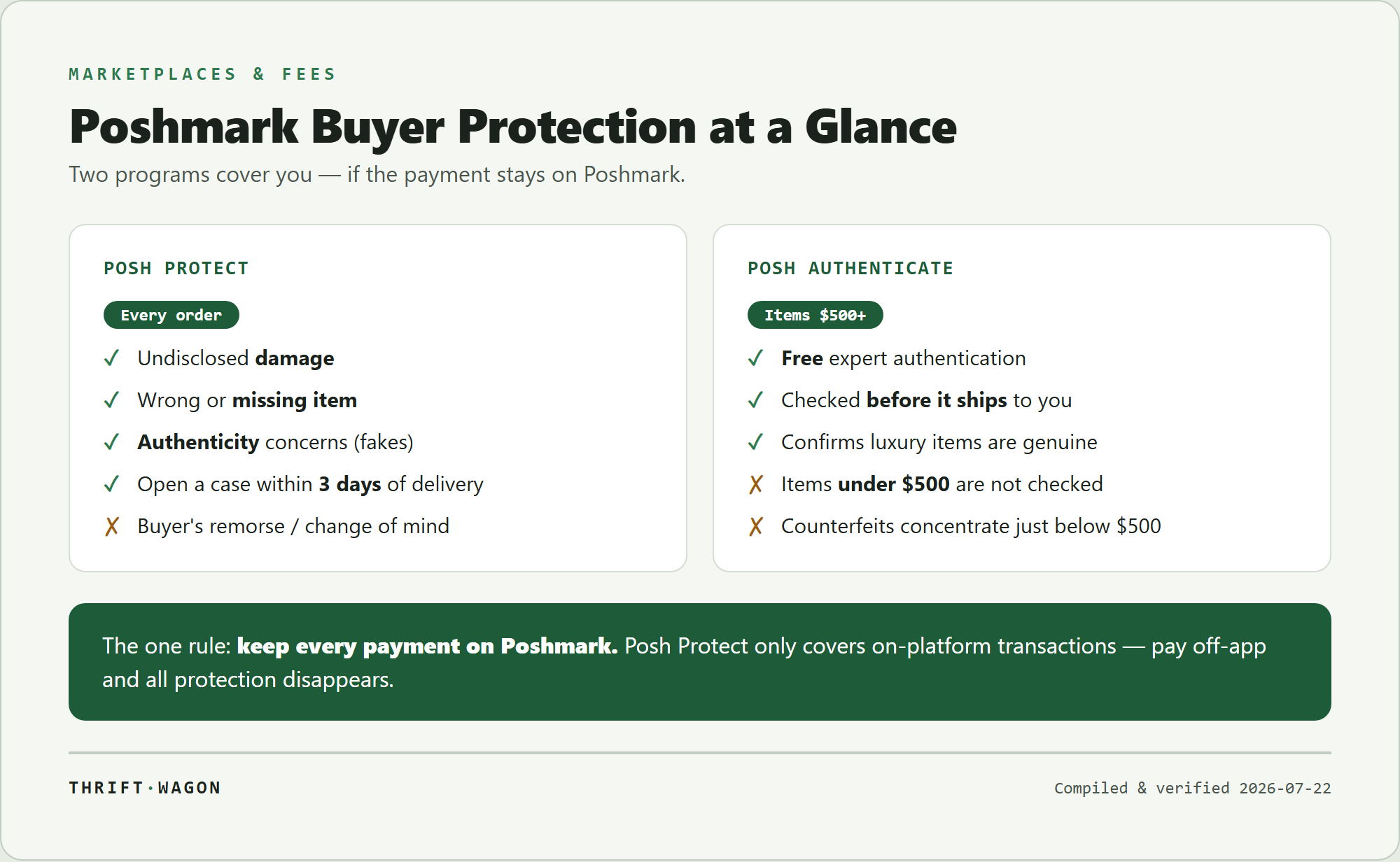
Posh Protect is Poshmark’s umbrella buyer-protection program, and it covers every purchase made on the platform. Within 3 days of delivery, a buyer can open a case for:
- undisclosed damage not shown or described in the listing,
- an incorrect or missing item, or
- authenticity concerns, where the item may be counterfeit.
If the case is decided in the buyer’s favor, Poshmark arranges the return and issues a refund. What Posh Protect does not cover is buyer’s remorse: Poshmark does not accept returns simply because a buyer changed their mind, decided it did not fit, or no longer wants the item. Cases are for genuine problems with the order, not a change of heart, which is an important expectation to set on both sides of a sale.
Posh Authenticate: free luxury authentication
For higher-value items, Poshmark adds a second layer. Posh Authenticate provides free authentication on items priced $500 or more: before the item ships to the buyer, it is routed through Poshmark’s experts at their headquarters to confirm it is genuine.
This is a genuine advantage for luxury buyers, because it puts a professional check between a designer listing and your doorstep at no extra cost. The important limit: items sold below $500 are not eligible for Posh Authenticate, so for a sub-$500 designer piece there is no pre-shipment authentication, and you are relying on the seller’s honesty plus your own inspection on arrival, backed by the authenticity coverage under Posh Protect if it turns out to be fake. Knowing the $500 line tells you exactly when the extra protection applies.

The one rule that keeps you safe: stay on-platform
Here is the rule every scam is built to break: Posh Protect only covers on-platform transactions. The moment a payment leaves Poshmark, all protections disappear.
Most Poshmark fraud is not about the marketplace itself; it comes from off-app payment requests. A scammer asks you to pay, or offers to pay you, through Zelle, Venmo, Cash App, or PayPal Friends & Family, usually framed as a discount or a faster deal. Once the money moves off-platform, Poshmark cannot help: if a buyer disputes the payment or a seller ghosts you, there is no case to open, and with Friends-and-Family style transfers you often cannot dispute it through your bank either.
The defence is absolute and simple: keep every payment and message inside Poshmark. A legitimate counterpart never needs to move you off-app. A request to do so is the single clearest sign of a scam, whatever reason accompanies it.
The common Poshmark scams, in detail
Poshmark scams cluster into a few patterns worth recognising by name.
Off-app payment requests. The master scam, as above: any push to transact outside Poshmark removes your protection and is the setup for most fraud.
Counterfeits under $500. Because Posh Authenticate only covers items $500 and up, fakes concentrate just below that line, where there is no pre-shipment check. Undisclosed-counterfeit purchases are still covered by Posh Protect if you open a case, but it is a hassle worth avoiding by buying from trusted sellers.
Chargebacks and item swaps (seller side). Sellers of high-end goods sometimes face buyers who file a chargeback after receiving an item, or return a different, inferior item claiming it is the original. Even sellers who follow policy can be exposed, which is why documentation matters.
Fake damage or not-as-described claims. A buyer opens a case claiming damage that did not exist, hoping for a refund while keeping the item. Honest, detailed listings and photos are the defence.
Phishing. Messages or links posing as Poshmark, trying to capture your login or payment details. Poshmark will not ask for your password in a message.
The common thread, again, is money moving off-platform or a lack of evidence. Both are manageable with the habits below.

How to spot a risky seller before you buy
Check the seller before you buy. Reassuring signals are the usual marks of a real, active shop: a history of positive reviews and love notes, clear original photos of the actual item, an established account, and responsive communication.
The red flags to avoid:
- A brand-new account with no sales and no reviews.
- Stock photos or copy-paste descriptions rather than real, specific ones.
- Suspiciously low prices on designer or high-demand items, the classic counterfeit bait, and especially anything just under the $500 authentication line.
- Pressure tactics designed to rush your decision.
- Any push to communicate or pay off Poshmark.
One genuine first-time seller is not a scammer, but two or more of these together, or any off-platform request, is a reason to slow down or pass.
What to do if something goes wrong: opening a case
If an item arrives damaged, wrong, or potentially fake, Posh Protect gives you a clear path, but the timing is strict.
- Act within 3 days of delivery. This is the window to open a case; after it closes and the order is accepted, the sale is final and the seller is paid.
- Open the case in the app on the order, selecting the reason (damaged, wrong item, or authenticity).
- Submit clear evidence: photos of the damage or discrepancy, and any relevant detail that supports your claim.
- Let Poshmark decide. Poshmark handles the entire dispute process and reviews the evidence from both sides.
- Return and refund. If the case is resolved in your favor, Poshmark assists with returning the item to the seller where applicable, and you receive a refund.
The key discipline is speed: inspect your purchase the day it arrives, and if anything is wrong, open the case immediately rather than waiting, because the 3-day window is the difference between a covered claim and a final sale.
Selling on Poshmark safely
Sellers get real protection from the structure, but should still defend themselves.
The 3-day acceptance window works in your favor: once a buyer accepts, or the window passes with no case, the sale is final and cannot be reversed through Poshmark for buyer’s remorse. That certainty is a genuine seller benefit.
The residual risks are chargebacks and item swaps on higher-value sales. Defend against them by shipping only with Poshmark’s tracked label, photographing the item and packaging before it ships, and describing items honestly with photos of any flaws, so a false not-as-described claim has no evidence behind it.
As always, keep everything on Poshmark and never accept off-app payment, which strips your protection just as it strips the buyer’s. A seller who ships tracked, documents condition, and lists honestly is in a strong position if a case is ever opened.
Keeping your account secure
Protect the account itself alongside individual sales. Poshmark will never ask for your password in a message, so treat any message or link that does, or that asks you to "verify" or "re-log in," as phishing. Open the app directly rather than logging in through a link someone sends you.
Use a strong, unique password you do not reuse elsewhere, and be suspicious of any message manufacturing urgency about your account, such as a threat of suspension unless you act now. A hijacked account can be used to run scams against your followers under your name, so account security protects your reputation as well as your balance.
Is Poshmark safer than other resale apps?
Poshmark holds up well against the other major resale apps, and its free authentication on items $500 and up is a real edge for luxury buyers that not every competitor matches. Its buyer protection, in-app payments, and defined case window are comparable to Depop, Vinted, and Mercari.
The shared vulnerability is identical across all of them: protection ends the instant a transaction moves off-platform. So Poshmark is not uniquely risky, and for luxury it is arguably a bit safer thanks to Posh Authenticate, but the determining factor is the same everywhere, whether you follow the on-platform rules. If you are weighing platforms on cost rather than safety, the meaningful differences are in the fees, which we cover separately.

So, should you use Poshmark?
Poshmark is a legitimate, publicly traded marketplace with genuinely useful protections: buyer coverage on every order, free authentication above $500, and a clear case process. For buying and selling fashion it works well when you use it as designed.
Use it with a few rules and problems are rare: keep everything on-platform, inspect purchases and open any case within the 3-day window, check the other party’s history, and document what you send. If a deal only works by going off-app, it is not a deal, it is the most common scam on the site wearing a discount. Follow those, and Poshmark is as safe as any major resale marketplace, and safer than most for luxury.
Frequently asked questions
Is Poshmark legit and safe to use?
Yes. Poshmark is a publicly traded US resale marketplace founded in 2011 and owned by Naver since 2023, with buyer protection on every order and free authentication on items over $500. Like any peer-to-peer platform it has some scammers, but on-platform purchases are protected against damage, wrong items, and counterfeits.
What is Posh Protect and what does it cover?
Posh Protect is Poshmark’s buyer protection on every purchase. Within 3 days of delivery you can open a case for undisclosed damage, an incorrect or missing item, or authenticity concerns, and if it is resolved in your favor you get a return and refund. It does not cover buyer’s remorse, so it is for genuine problems, not a change of mind.
Does Poshmark authenticate items?
Yes, for items priced $500 or more. Posh Authenticate routes those luxury items through Poshmark’s experts to confirm they are genuine before they ship to the buyer, at no extra cost. Items sold below $500 are not authenticated, so for a sub-$500 designer piece you rely on the seller and your own inspection, backed by Posh Protect’s authenticity coverage.
Can you get scammed on Poshmark?
You can, but most Poshmark fraud comes from off-app payment requests rather than the marketplace itself. Posh Protect only covers on-platform transactions, so if you pay or get paid via Zelle, Venmo, or PayPal Friends & Family, you lose all protection. Keeping everything on Poshmark defeats the large majority of scams.
How do I open a case on Poshmark?
Open the case in the app on the order within 3 days of delivery, choose the reason (damaged, wrong item, or authenticity), and submit clear photos as evidence. Poshmark reviews both sides and handles the process; if resolved in your favor, it arranges the return and issues your refund. Acting within the 3-day window is essential.
Is Poshmark safe for sellers?
Largely, thanks to the 3-day acceptance window that makes a completed sale final and blocks buyer’s-remorse reversals. The residual risks are chargebacks and item-swap claims on higher-value goods. Defend against them by shipping with Poshmark’s tracked label, photographing the item and packaging before sending, and describing items honestly with photos of flaws.
Does Poshmark accept returns?
Only for genuine problems, not buyer’s remorse. Poshmark does not let buyers return an item simply because they changed their mind, it did not fit, or they no longer want it. Returns and refunds are available through Posh Protect when an item is damaged, wrong, missing, or not authentic, and a case is opened within 3 days of delivery.
Are cheap designer items on Poshmark real?
Be careful. Counterfeits concentrate just under the $500 line, because items below that are not run through Posh Authenticate. A designer piece priced far below market is a classic counterfeit signal. Buy from sellers with strong reviews and real photos, and if a sub-$500 item turns out fake, open an authenticity case under Posh Protect within 3 days.
How we checked this
Compiled Poshmark’s legitimacy, ownership, Posh Protect coverage, Posh Authenticate threshold, dispute process, and common scam patterns from marketplace-safety guides and consolidated them into a full safety guide Posh Protect and Posh Authenticate terms, the 3-day case window, and the recurring scam types. Collected 2026-07-22.
What this guide does not cover
This guide explains how Poshmark’s protection, authentication, and disputes work at a general level, and Poshmark’s exact terms, thresholds, windows, and processes can change, so confirm the current details in the app and Poshmark’s own help pages before relying on them. It is general safety information, not a guarantee against every scam, and outcomes of individual cases vary. Always read the platform’s current buyer-protection terms.
Sources
- Poshmark legitimacy, founding, Nasdaq listing and Naver acquisition, Posh Protect coverage, Posh Authenticate $500 threshold, and seller risks — Nifty
- Poshmark scams for buyers and sellers, off-app payment risk, chargebacks and item swaps, and how to stay safe — Onerep