Poshmark vs eBay (2026): Which Should You Sell On?
Verified 2026-08-10
Poshmark is a fashion-focused social marketplace where buyers pay shipping and sellers grow sales by sharing; eBay is an everything marketplace with a huge search-driven audience. Poshmark charges a flat $2.95 on sales under $15 and 20% at $15 or more, while eBay charges around 13.6% plus a small per-order fee. The right choice depends on what you sell and how you like to sell. This guide compares their fees, shipping, audiences, and selling style, with a worked example.

Key takeaways
- Poshmark charges sellers $2.95 on sales under $15 and 20% on sales of $15 or more, with no listing or payment processing fees.
- eBay charges a final value fee of around 13.6% for most categories plus a per-order fee of $0.30 to $0.40, with 250 free listings a month.
- On Poshmark the buyer pays a flat shipping fee; on eBay the seller usually sets and often absorbs shipping, which changes the real economics.
- Poshmark is best for brand-name fashion sold to a social, sharing-driven community; eBay is best for used, niche, and collectible goods sold to searchers.
- eBay’s percentage fee is lower, but Poshmark’s buyer-paid shipping and fashion audience can net out competitively for clothing.
Poshmark vs eBay: the short answer
Both are legitimate marketplaces, and the decision is mostly about what you sell and how you like to sell.
Choose Poshmark if you sell brand-name clothing, shoes, and accessories and are happy to share listings and engage a community. Its fashion audience, social discovery, and buyer-paid shipping make it a natural home for apparel.
Choose eBay if you sell used, niche, or collectible items across any category and want a huge search-driven audience: electronics, cards, sneakers, parts, and hard-to-find goods that buyers look up by name.
The overlap is fashion, where both work but reward different effort: Poshmark rewards sharing and social selling, eBay rewards precise, searchable listings. eBay’s percentage fee is lower, but Poshmark shifts shipping onto the buyer, so the real economics are closer than the headline numbers suggest. The rest of this guide breaks it down.
Fees compared in 2026
The headline fee structures look very different, so compare them carefully.
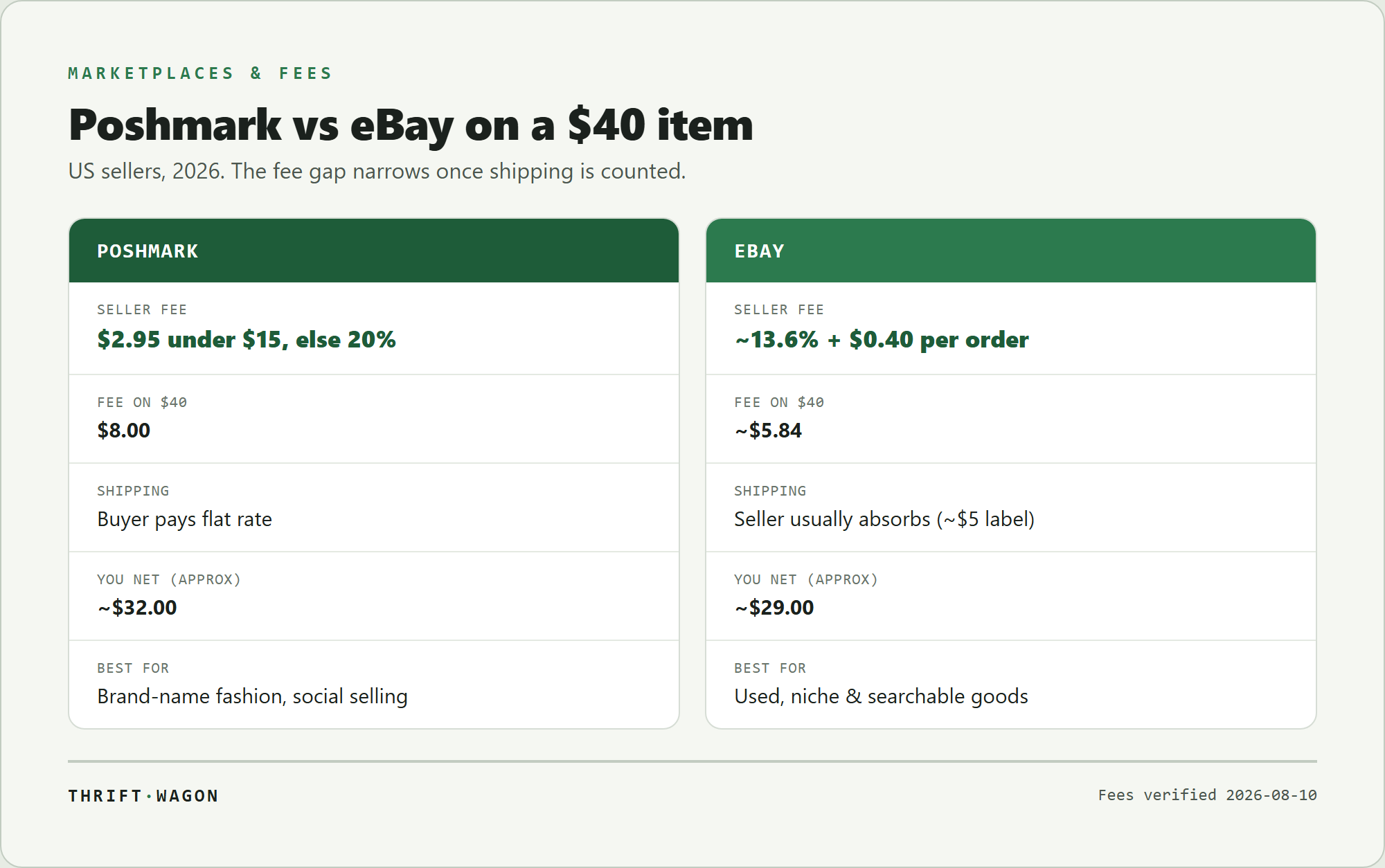
Poshmark keeps it simple: $2.95 flat on sales under $15, and 20% on sales of $15 or more. There is no listing fee and no payment processing fee. On a $40 item, Poshmark’s fee is $8.00.
eBay charges a final value fee of around 13.6% for most categories on the total including shipping, plus a per-order fee of $0.30 or $0.40, with payment processing included and 250 free listings a month. On a $40 item, eBay’s fee is about $40 x 13.6% + $0.40 = $5.84.
So on the item price alone, eBay is cheaper: about $5.84 versus $8.00. But that is not the whole story, because the two handle shipping completely differently, which is the next section. For eBay’s full fee detail, see our guide to eBay’s selling fees, and for a cross-platform view, our marketplace fee comparison.
Shipping changes the math
Fees alone favor eBay, but shipping is where Poshmark closes the gap, so this is the section that decides real profit.
On Poshmark, the buyer pays shipping. Poshmark sets a flat-rate label (USPS Ground Advantage for standard packages up to a set weight), and the buyer pays it at checkout. The seller keeps the full item price minus the selling fee, unless they choose to offer a shipping discount, which comes out of their earnings.
On eBay, the seller sets shipping and usually absorbs it, either as free shipping (cost built into the price) or a shipping charge that the final value fee then applies to. Either way, the seller typically carries the shipping cost.
So revisit the $40 item. On Poshmark you net about $32.00 (price minus the $8.00 fee), and the buyer pays shipping. On eBay, after the $5.84 fee you also pay to ship, so if a label costs about $5, you net closer to $29. Once shipping is included, the two land close together for clothing, which is why the choice comes down to audience and style more than fees.

Audience and how items sell
This is the real deciding factor, because the two attract different buyers.
Poshmark is a social, fashion-first community. Buyers browse and follow, and sellers drive sales by sharing their listings and others’, joining Posh Parties, and sending offers to likers. It is strongest for brand-name clothing, shoes, bags, and accessories, where the social feed and style discovery shine. The trade-off is that selling is active: sharing regularly is part of the job.
eBay is a search-driven everything-store. Buyers arrive knowing the item they want and filter by model, condition, and price, which makes eBay unbeatable for used, niche, and collectible goods and for anything specific and searchable. It also offers auctions for rare or hard-to-price items.
The practical rule: brand-name fashion thrives on Poshmark’s community; a specific, searchable item (a camera, a card, a part) thrives on eBay’s demand. A generic non-fashion item does not belong on Poshmark, and expecting Poshmark-style social lift on eBay misreads the platform.

Selling style and effort
The daily work differs, and it suits different sellers.
Poshmark is active and social. The lever that moves sales is sharing: re-sharing your closet daily, sharing to parties, and following and engaging. Offers to likers close a lot of sales. If you enjoy the community side, it rewards you; if you want to list and walk away, the sharing routine can feel like a chore.
eBay is research-led. Winning listings need a keyword-rich title, accurate item specifics, and pricing from real sold listings, and many sellers add Promoted Listings to compete. It is front-loaded effort per listing rather than daily social work.
Neither is harder overall, they suit different temperaments. Poshmark fits sellers who like engaging a community around fashion; eBay fits sellers who like precise, data-based listings across any category. To price like an eBay seller, learn to read sold listings, and for a full walkthrough see our guide to selling on Poshmark.

Which should you choose?
Match the platform to your inventory and how you like to sell:
- Choose Poshmark for brand-name clothing, shoes, and accessories, especially if you enjoy the social, sharing-driven side and want the buyer to pay shipping.
- Choose eBay for used, niche, collectible, electronic, or non-fashion items that buyers search for by name, where the huge audience and lower percentage fee win.
- Use both if you sell a mix: fashion on Poshmark, everything else (and higher-value or collectible fashion) on eBay. Cross-listing the same clothing to both is common and simply widens your reach.
The summary: eBay has the lower percentage fee and the bigger audience; Poshmark shifts shipping to the buyer and offers a fashion community that sells clothing well. For apparel, the two net out closer than the headline fees suggest, so choose on audience and selling style. For a broader view of where each item earns most, see our marketplace fee comparison.

Frequently asked questions
Is Poshmark or eBay better for selling clothes?
Both work for clothing. Poshmark is better for brand-name fashion sold to a social, sharing-driven community, with the buyer paying shipping. eBay is better if you want a larger search-driven audience and lower percentage fees, and it also handles non-fashion items. For apparel, the two net out closer than the headline fees suggest.
Is Poshmark or eBay cheaper?
On the item price, eBay is cheaper: about 13.6% plus a per-order fee, versus Poshmark’s flat 20% at $15 or more. On a $40 item that is roughly $5.84 on eBay versus $8.00 on Poshmark. But Poshmark’s buyer pays shipping while eBay sellers usually absorb it, so real profit lands closer together.
What are Poshmark’s fees in 2026?
Poshmark charges sellers $2.95 on sales under $15 and 20% on sales of $15 or more, with no listing fee and no payment processing fee. The buyer pays a flat-rate shipping fee at checkout. If a seller offers a shipping discount, that amount comes out of their earnings.
Who pays shipping on Poshmark vs eBay?
On Poshmark the buyer pays a flat-rate shipping fee, so the seller keeps the item price minus the selling fee. On eBay the seller sets shipping and usually absorbs it, either as free shipping built into the price or a charge the final value fee then applies to. This shipping difference narrows the fee gap.
Does eBay have more buyers than Poshmark?
Yes. eBay has a much larger, search-driven audience across every category, which is why it sells used, niche, and collectible items faster and for more. Poshmark has a large, focused audience specifically for fashion, where its social discovery and sharing tools help clothing sell within that community.
Can I sell on both Poshmark and eBay?
Yes, and many sellers do. A common approach is to list fashion on Poshmark for its community and buyer-paid shipping, and list non-fashion, higher-value, or collectible items on eBay for its reach and lower percentage fee. Cross-listing the same clothing to both widens your audience for the cost of your time.
What sellers are reporting
Sellers who use both platforms repeatedly point out that Poshmark’s 20% looks high until you account for the buyer paying shipping, whereas eBay’s lower percentage is offset by the seller usually covering the label, so for clothing the two end up close.
members of the r/Flipping community, community post
Poshmark sellers frequently report that consistent sharing and sending offers to likers are the biggest drivers of sales, and that the platform rewards active, social selling far more than listing and waiting.
members of the r/poshmark community, community post
What this guide does not cover
This compares Poshmark and eBay for US sellers in 2026; fees, shipping rates, and features change, so confirm current details on each platform. Which nets more depends on the item and shipping cost, so treat the worked example as illustrative. This is general guidance, not financial advice.
Sources
- Poshmark charges sellers $2.95 on sales under $15 and 20% on sales of $15 or more, with no listing or payment processing fee, and the buyer pays flat-rate shipping. (Poshmark)
- eBay’s final value fee is around 13.6% for most categories on the total including shipping, plus a per-order fee of $0.30 or $0.40, with 250 free listings a month. (eBay Help)
- Marketplace fee comparison across eBay, Poshmark, Etsy, Mercari, and Depop. (Thrift Wagon)