Etsy vs Shopify (2026): Which Should You Sell On?
Verified 2026-08-10
Etsy is a marketplace that brings you buyers for a per-sale fee; Shopify is a platform for building your own store, where you pay a monthly subscription and bring your own traffic. Etsy is easier to start and comes with an audience, while Shopify gives you a branded store, lower per-sale costs at volume, and full ownership of your customers. The right choice depends on your sales volume and whether you can drive traffic. This guide compares their fees, traffic, and control, with a break-even example.

Key takeaways
- Etsy is a marketplace with a built-in audience and per-sale fees; Shopify is your own store with a monthly subscription and no built-in traffic.
- Etsy charges $0.20 to list plus 6.5% and payment processing per sale; Shopify’s Basic plan is about $25 a month (or $19 billed annually) plus card processing.
- Shopify becomes cheaper per sale at higher volume, but only if you can bring your own visitors, because it sends you no traffic.
- Etsy owns the customer relationship and search discovery; Shopify gives you full control of branding, data, and the customer list.
- Many sellers use both: Etsy for discovery and Shopify for their brand, repeat buyers, and higher margins.
Etsy vs Shopify: the short answer
They are two different tools, so the choice is not really head-to-head. Etsy is a marketplace: you list in a busy shopping site that already has millions of buyers, and you pay a fee on each sale for that reach. Shopify is a storefront builder: you get your own branded website, and you pay a monthly subscription, but no one visits unless you send them.
Choose Etsy if you want the easiest start and a built-in audience, especially for handmade, vintage, or craft products, and you do not yet have your own traffic.
Choose Shopify if you want a branded store, lower per-sale costs at volume, and full ownership of your customers, and you can drive traffic through social media, ads, email, or an existing following.
The honest answer for many sellers is both: use Etsy to get discovered and Shopify to build a brand and keep repeat customers. The rest of this guide shows the fees and the break-even so you can decide.
The core difference: audience vs ownership
This is the distinction that decides everything else, so it is worth being clear about.
Etsy gives you an audience but not ownership. Buyers find you through Etsy search and Etsy’s brand, which is powerful when you are starting out. But the customer belongs to Etsy: you compete with similar shops on the same page, you follow Etsy’s rules, and you cannot easily market to past buyers or build a distinct brand.
Shopify gives you ownership but not an audience. Your store is yours: your branding, your checkout, your customer list and data, and no direct competitors on your product page. The catch is that Shopify sends you zero traffic, so every visitor comes from your own social media, ads, email, SEO, or word of mouth.
So the trade is simple: Etsy rents you traffic; Shopify sells you a house you must fill yourself. If you cannot yet bring visitors, Etsy’s audience is worth its fee. If you can, Shopify’s ownership and margins pull ahead.

Etsy’s fees in 2026
Etsy has almost no fixed cost and takes a percentage per sale. For US sellers:
- Listing fee: $0.20 per item, lasting four months or until it sells.
- Transaction fee: 6.5% of the total the buyer pays, including shipping.
- Payment processing: about 3% plus $0.25 per order in the US.
Together these come to roughly 10 to 12 percent of a sale plus the small listing fee, so on a $30 sale expect about $3.30 in total fees. Optional costs include Offsite Ads (12% or 15% on attributed sales, mandatory above $10,000 in annual sales) and on-site Etsy Ads.
The key point is that Etsy has no monthly fee (unless you add the optional Etsy Plus), so it costs nothing to keep listings up during slow months. That makes it low-risk to start and to test products. For the complete breakdown, see our guide to Etsy’s seller fees.
Shopify’s costs in 2026
Shopify flips the model: a monthly subscription plus card processing, and no per-item listing fee.
- Plans: Basic is about $25 a month (around $19 billed annually), Grow about $65 ($49 annually), and Advanced about $399 ($299 annually). A lightweight Starter plan (around $5) adds buy buttons to social or an existing site.
- Card processing: using Shopify Payments, online rates are about 2.9% + $0.30 per transaction on Basic, decreasing on higher plans.
- Extra transaction fee: if you use a third-party payment gateway instead of Shopify Payments, Shopify adds 2% on Basic (1% on Grow, 0.6% on Advanced). Using Shopify Payments avoids this.
So the per-sale cost on Shopify (with Shopify Payments) is mostly just card processing, far below Etsy’s stacked fees. But you also pay the monthly subscription whether you sell or not, and you must supply all the traffic. That fixed cost is the trade-off for ownership and low per-sale fees.

A break-even example
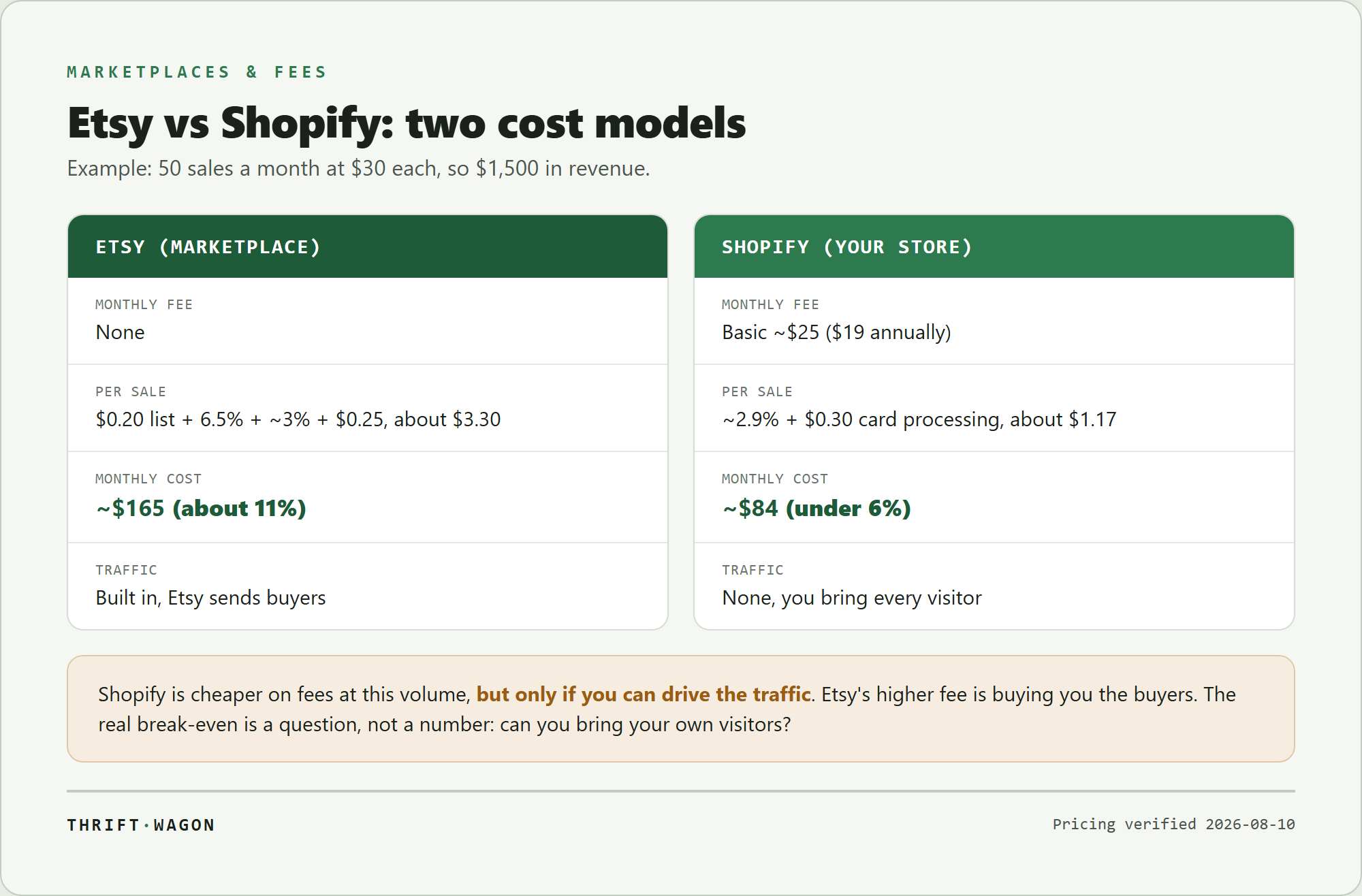
Numbers make the trade-off concrete. Take 50 sales a month at $30 each, so $1,500 in revenue.
On Etsy: roughly $3.30 per sale in fees times 50 is about $165 a month, or about 11%, with no subscription. The upside baked into that fee is that Etsy sent you buyers.
On Shopify (Basic with Shopify Payments): card processing of about $1.17 per sale ($30 x 2.9% + $0.30) times 50 is about $59, plus the $25 subscription, so about $84 a month, under 6%. But that assumes you brought all 50 buyers, since Shopify sends none.
So Shopify is clearly cheaper on fees at this volume, if you can drive the traffic. If you cannot, Etsy’s higher fee is buying you the customers you would otherwise have to find and pay for. The break-even is not really a dollar figure, it is the question: can you bring your own visitors?

Which should you choose?
Decide based on where you are, not on which platform is ‘better’:
- Choose Etsy if you are starting out, testing products, or cannot yet drive traffic, and you sell handmade, vintage, or craft goods. The built-in audience and zero monthly cost make it the low-risk on-ramp.
- Choose Shopify if you have steady volume and can bring visitors through social, ads, email, or an audience, and you want a branded store, your own customer data, and lower per-sale fees.
- Use both once you are established: let Etsy handle discovery and new-customer reach, and use Shopify to build your brand, capture repeat buyers, and earn higher margins on the traffic you own.
The summary: Etsy is the easiest way to get in front of buyers; Shopify is the best way to own the relationship once you can bring them yourself. Most successful sellers graduate from one to the other, or run both. If your product is handmade or vintage and you are still deciding where to begin, our guide to selling on Etsy is the fastest starting point.

Frequently asked questions
Is Etsy or Shopify better for beginners?
Etsy is better for most beginners. It has a built-in audience, costs nothing per month, and lets you list an item for $0.20, so you can start and test products with almost no risk. Shopify suits sellers who already have steady sales and can drive their own traffic to a branded store.
Is Shopify cheaper than Etsy?
Per sale, yes, at volume. Shopify’s cost is mostly card processing (about 2.9% + $0.30) plus a monthly subscription from about $25, while Etsy stacks a 6.5% fee, processing, and a listing fee, near 11% per sale. But Shopify sends no traffic, so its lower fees only pay off if you can bring your own buyers.
Does Shopify bring you traffic like Etsy?
No. Etsy is a marketplace with millions of shoppers who find you through its search, while Shopify is your own website that gets no visitors unless you send them. On Shopify you supply all traffic through social media, ads, email, SEO, or an existing audience, which is the main trade-off for its lower fees.
What are Etsy’s and Shopify’s fees in 2026?
Etsy charges $0.20 to list plus a 6.5% transaction fee and about 3% + $0.25 processing per sale, roughly 11% total with no monthly fee. Shopify’s Basic plan is about $25 a month ($19 annually) plus about 2.9% + $0.30 card processing with Shopify Payments, and a 2% extra fee only if you use a third-party gateway.
Can I use both Etsy and Shopify?
Yes, and many sellers do. A common path is to use Etsy for discovery and new customers, and Shopify to build a branded store, capture repeat buyers, and earn higher margins on traffic you own. Some sellers list the same products on both and drive their own audience to the Shopify store over time.
When should I switch from Etsy to Shopify?
Consider Shopify once you have steady, repeatable sales and can drive your own traffic through social media, ads, email, or an existing following. At that point Shopify’s lower per-sale fees and full ownership of branding and customer data outweigh its monthly cost. Until you can bring visitors, Etsy’s built-in audience is usually worth its higher fee.
What sellers are reporting
Sellers repeatedly advise newcomers to start on Etsy for its built-in traffic and only move to or add Shopify once they can drive their own visitors, warning that a Shopify store with no marketing simply sits empty despite the lower fees.
members of the r/Etsy community, community post
Established sellers frequently report running both, using Etsy for discovery and Shopify to capture repeat customers and build a brand, since Shopify lets them own the customer list and email that Etsy keeps.
members of the r/EtsySellers community, community post
What this guide does not cover
This compares Etsy and Shopify for US sellers in 2026; plan prices, fees, and processing rates change and vary by region and plan, so confirm current details on each platform. The break-even example is illustrative and depends on your volume and traffic. This is general guidance, not financial advice.
Sources
- Shopify’s Basic plan is about $25 a month (around $19 billed annually), with higher Grow and Advanced tiers, plus an extra transaction fee of 2% on Basic when not using Shopify Payments. (Shopify)
- Etsy charges a $0.20 listing fee, a 6.5% transaction fee on the total including shipping, and payment processing that varies by country. (Etsy)
- Breakdown of Etsy’s seller fees, including listing, transaction, processing, and Offsite Ads fees. (Thrift Wagon)